
More real estate agents in Orlando are rethinking where they hang their license, and the reason is straightforward. As the real estate market shifts, the percentage split that once felt like the cost of doing business is getting harder to justify.
As MLS access, transaction platforms, and marketing systems have become available outside traditional brokerage bundles, the percentage-based commission split has become harder to justify at higher production levels. For agents building a book of business in one of the fastest-growing metros in the country, that’s a real career decision worth studying.
This post walks you through what a 100% commission real estate brokerage in Orlando actually is, how the fee models differ, and what to weigh beyond the headline number so you can make a well-informed choice. We’ll also show how Charles Rutenberg Realty fits into that picture as one of the largest brokerages in Florida.
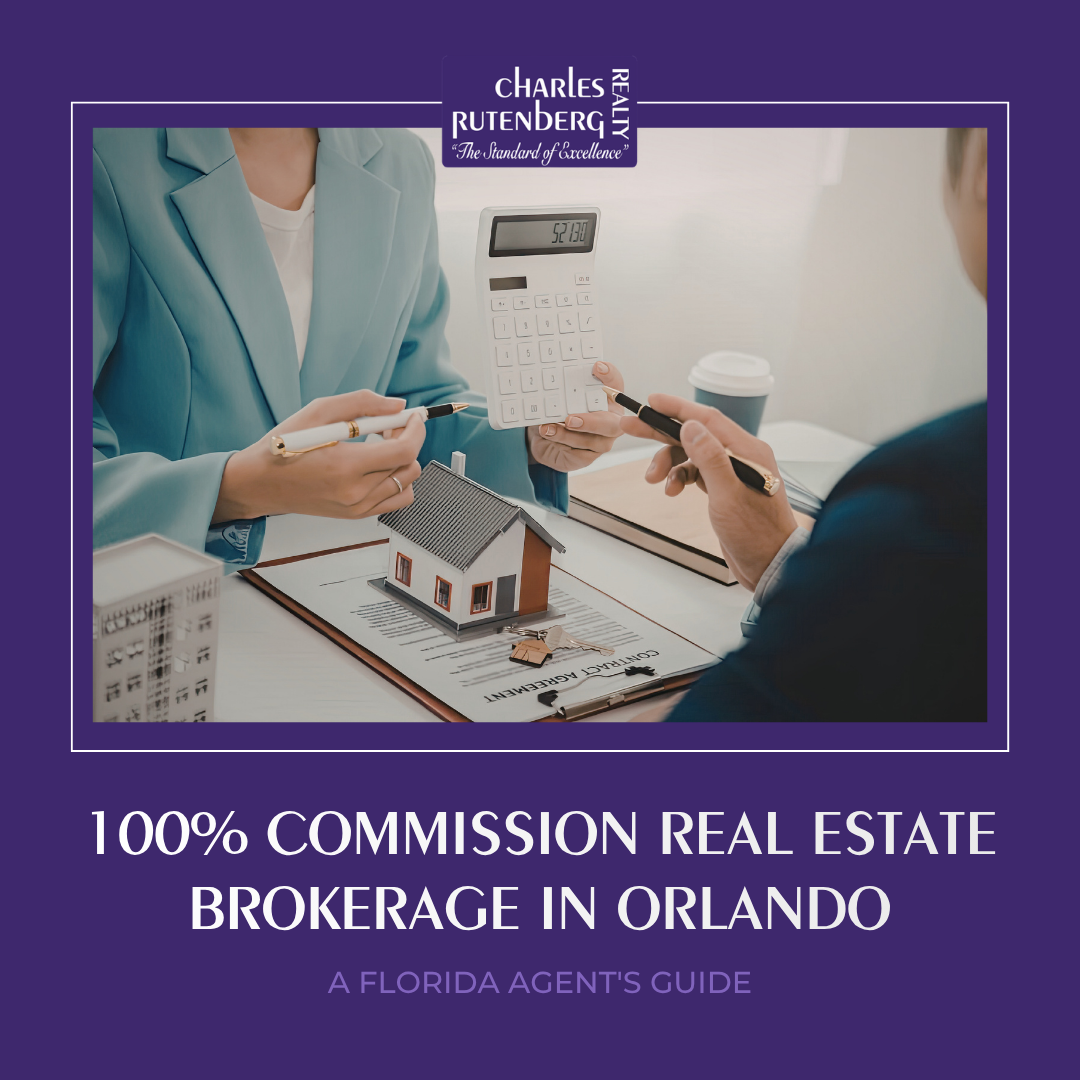
100% Commission Real Estate Brokerage in Orlando: What to Compare
Before you choose a 100% commission brokerage in Orlando, it helps to understand where these models sit in today’s market. Several factors contribute to the dynamics of the Orlando market, including population growth, economic stability, and the appeal of Florida’s climate and lifestyle.
That steady demand gives agents a reliable transaction flow, which is exactly why the math matters here. When your pipeline is consistent, the fees you pay and the commission you keep have a larger cumulative effect on your annual income.
However, your earning potential is shaped by more than one variable. Deal volume, average sale price, the fees your brokerage charges, and the support you actually use all factor in.
According to data, the median home value in the Orlando-Kissimmee-Sanford metro area averaged around $427,500 as of 2025. In a market with prices in that range, the difference between a percentage split and a flat fee can be significant across a full year of closings.
A 100% commission model does not mean zero brokerage fees. Charles Rutenberg Realty Orlando operates on a 100% Commission model, and there are still costs that keep the business running. We’ll explain how those work throughout this post so you can compare the full compensation structure rather than a single number.
Comparing more than the commission line is the difference between a decision that looks good on paper and one that pays off in practice.
What Is a 100% Commission Real Estate Brokerage?
In a flat-fee or 100% commission model, the agent keeps the entire commission and pays the brokerage a fixed amount instead. This is usually a monthly desk fee, a per-transaction fee, or both. Rather than providing a percentage of every check, you cover a defined cost and keep what remains.
Compare that to the traditional structure most agents start under. In a traditional brokerage, every commission you earn is split with the broker (typically 70/30 or 60/40) until you hit an annual production threshold, after which you might earn higher splits.
That arrangement can work well early in a career when you lean heavily on in-house training and lead flow. As production grows, though, the split can outpace the value you receive in return. The 100% model flips the equation, but it comes with a trade-off worth noting: support.
Flat-fee brokerages typically offer fewer services, less transaction coordination, fewer tools, less coaching, and may still charge for errors and omissions (E&O) insurance, transaction fees, or marketing. This is where brokerages diverge sharply.
Charles Rutenberg Realty pairs the 100% Commission model with training programs, technology, and a collaborative environment, so you keep your commission without giving up the infrastructure that helps you close. You can read more about how the model works on our 100% Commission Real Estate Brokerage page.
How Do Commission Structures Work for Real Estate Agents?
Every brokerage builds its commission structure differently, and the labels can blur together. The most common approaches fall into a handful of buckets, and knowing them helps you read any offer quickly.
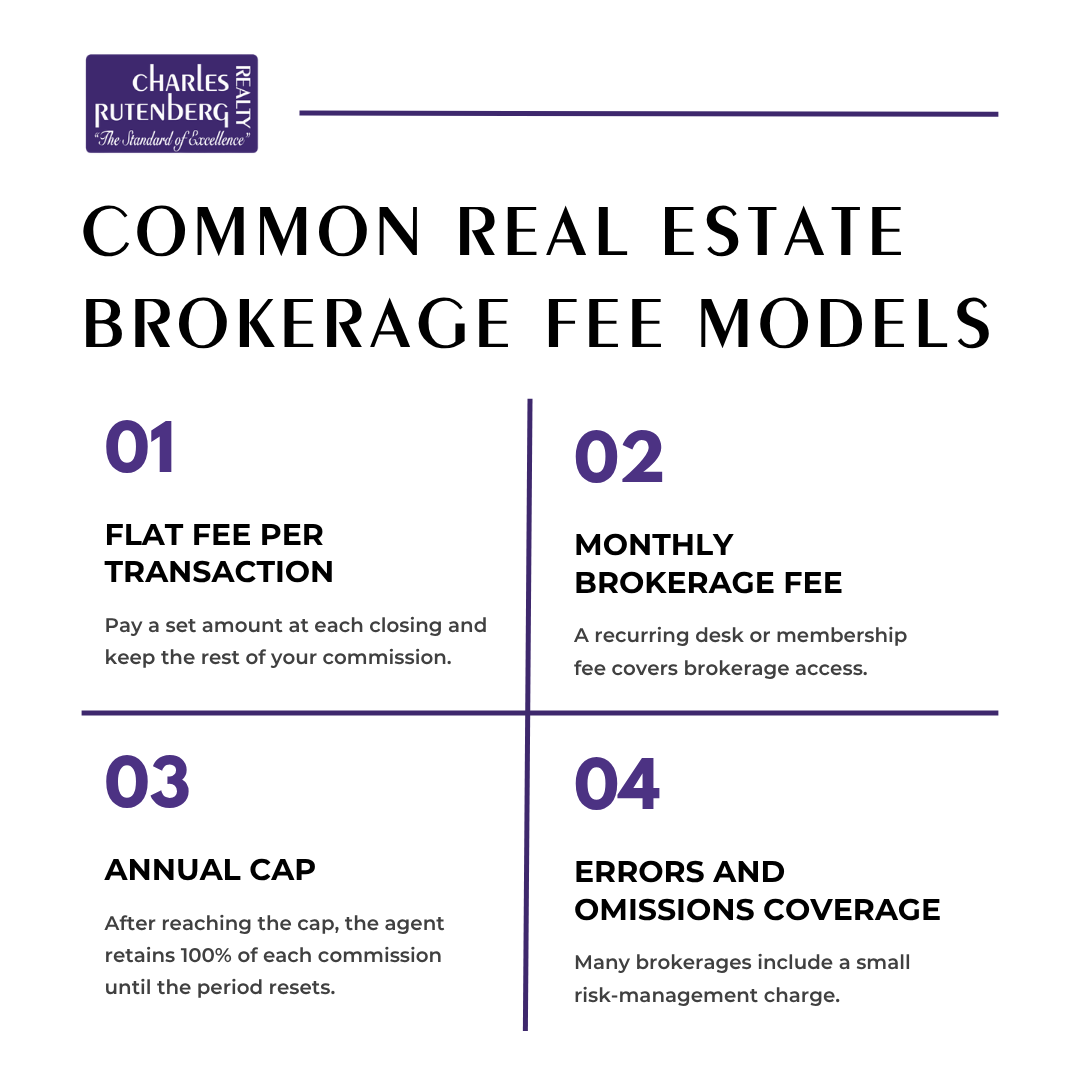
Here are the fee models you’re most likely to encounter:
- Flat Fee Per Transaction: You pay a set amount at each closing and keep the rest of your commission on that home sale.
- Monthly Brokerage Fee: A recurring desk or membership fee covers your access to the brokerage regardless of how many deals you close that month.
- Annual Cap: When an agent reaches the cap threshold, the brokerage stops collecting its share of commissions for the remainder of the annual period. After capping, the agent retains 100% of each commission until the period resets.
- Errors and Omissions Coverage: Many brokerages fold in a small risk-management charge.
Because every brokerage sets its own policies, the right move is to compare the entire compensation package. Agents should confirm fee structures directly with each brokerage before signing a contract.
Add up the transaction fees, recurring fees, technology costs, and the value of the support you’ll genuinely use. If you want a deeper breakdown of the numbers, this guide walks through the mechanics in more detail: “How Much Is Realtor Commission?”
Are There Real Estate Brokerages With 100% Commission in Orlando?
Yes, Orlando has several real estate brokerages offering 100% commission models, and the market has grown as more agents seek to keep more of what they earn.
Traditional real estate brokerage model commission splits range anywhere from 50% to 90%, meaning the agent takes home between 50% to 90% of GCI, depending on a number of factors. A flat-fee structure is an answer to that range, and Central Florida agents now have real choice.
The catch is that not all of these brokerages are alike. Each one provides different levels of training, support, technology, marketing, and fees. Some are cloud-based with minimal in-person contact, while others maintain a physical office and hands-on broker access.
As you compare, look past the shared “100% Commission” headline to what each firm actually delivers day to day. Our post, “How to Choose a Real Estate Brokerage to Work For” is a useful companion when you’re weighing several options at once.
Pros of a 100% Commission Brokerage
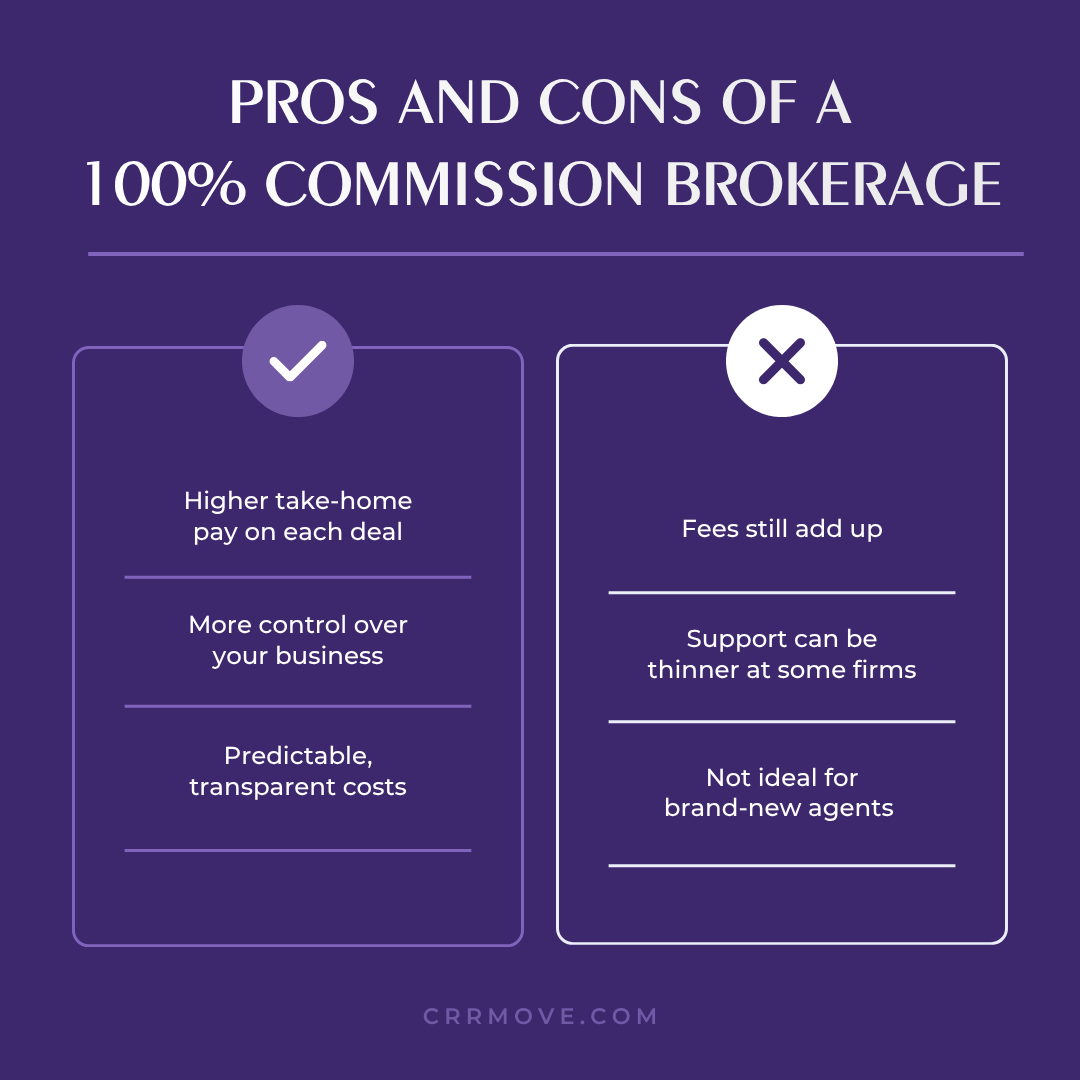
Higher Take-Home Pay on Each Deal
The most immediate advantage is financial. When you keep your full commission and pay a predictable fee instead of a split, more of each home sale stays with you. For example, an agent producing $125,000 GCI across 20 deals and paying a $500 fee per transaction would pay $10,000 in fees, retaining $115,000 before additional business expenses.
For established agents with steady volume, those retained dollars compound quickly across a full year.
More Control Over Your Business
A flat-fee model tends to hand agents more autonomy over how they market, brand, and run their operation.
The model is not universally optimal across all career stages. However, for mid-career and veteran agents with established pipelines, the financial advantage of retaining full commission in exchange for transparent flat fees has become difficult to ignore.
That independence appeals to entrepreneurial agents who already know how they want to work.
Predictable, Transparent Costs
Flat fees are easier to plan around than a moving percentage. You know the transaction fee before you close, so you can forecast your net on each deal. That clarity makes budgeting for marketing, technology, and continuing education far more straightforward across a full production year.
Cons of a 100% Commission Brokerage
Fees Still Add Up
“100%” never means free, and pretending otherwise sets agents up for a surprise. Some standard fees at other 100% commission brokerages may include transaction fees, E&O insurance fees, technology fees, desk fees, annual fees, franchise fees, and training fees, among others.
These charges can accumulate over time, leading to a significant impact on an agent’s take-home pay. Read the fee schedule in full before you sign anything.
Support Can Be Thinner at Some Firms
At certain flat-fee brokerages, low fees can mean little help. The first misconception is that 100% commission means no broker support. In a poorly run 100% commission brokerage, that can be true. The remedy is to confirm exactly what training, transaction coordination, and technology come with the fee, which is where a well-supported brokerage separates itself.
Not Ideal for Brand-New Agents
The model rewards agents who already have a pipeline and know the mechanics of a transaction. For newly licensed agents, gaining a year or two of experience under a more traditional, high-support brokerage is still solid advice. Following this, you can then take your business wherever the math works best.
If you’re just starting out, weigh how much hands-on guidance you’ll need. Our guide, How to Become a Real Estate Agent in Orlando, FL, is a good place to begin if you’re early in the journey.
What Are 100% Commission Real Estate Brokerages in Orlando?
Several well-known 100% commission real estate brokerages operate in the Orlando area, each with its own fee structure and support model. The descriptions below are factual and meant to help you compare, not to rank one over another.
Charles Rutenberg Realty
Charles Rutenberg Realty is a Florida brokerage founded in 2000 and one of the largest and most respected real estate companies in the region, with 2,100+ agents. The Orlando office represents the brokerage’s expansion into the Central Florida market.
It pairs a 100% Commission model and low fees with training programs, marketing tools, technology, and a collaborative environment. This foundation makes it well suited to experienced, entrepreneurial agents who want to keep their commission without losing infrastructure and support.
eXp Realty
eXp is a large cloud-based brokerage that reaches 100% commission through a capped split rather than a flat fee from day one. eXp operates on an 80/20 split with a $16k cap and only hits 100% after you cap. It tends to suit agents comfortable with a virtual, technology-driven environment and a revenue-share component.
HomeSmart and Realty ONE Group
HomeSmart and Realty ONE Group take a different approach by offering 100% commission from day one rather than requiring agents to reach a cap first. Instead of giving up a percentage of each commission until that threshold is met, agents typically pay transaction, membership, or other brokerage fees depending on the specific plan and market.
This structure may appeal to agents who want to keep more of each commission from the beginning of the year while still working under a national brokerage brand.
Regional Flat-Fee Firms
Central Florida also has smaller flat-fee brokerages built around a simple per-closing charge. For example, some Orlando firms use a tiered flat-fee structure based on the sale price, with fees that start at a set amount for lower-priced sales and increase modestly as the sale price rises.
These can appeal to independent agents who want minimal overhead and don’t lean on in-office coaching. As always, confirm the full fee schedule and the level of support before deciding.
Choosing the Right Central Florida Brokerage for Your Career
The Orlando lifestyle is one of your strongest selling tools, and the market backing it is durable. Agents who can speak to that lifestyle, from the theme parks and lakes to growing employment centers like Lake Nona, give their clients a reason to buy here. That skill pays particularly when an agent joins a supportive, collaborative brokerage.
When the transaction flow is this steady, where you hang your license shapes how much of your success you keep. Charles Rutenberg Realty offers a 100% Commission model, low fees, technology, training programs, and marketing tools inside a collaborative environment built for agents who want to run their own business with real support behind them. If that fits your vision, we’d like to talk.
Apply to Charles Rutenberg Realty today, learn more on our Work With Us page, and schedule a call with our broker to see whether the fit is right for you. Likewise, for those interested in buying a home or selling a home, Charles Rutenberg Realty is here to help.
This post is for general informational purposes only and does not constitute legal, tax, or financial advice. Fee structures, licensing requirements, and market figures change over time, so please verify current details and consult a qualified professional before making a career or financial decision.