Becoming a Realtor in Florida is one of the more accessible career paths available. No degree is required, a defined licensing process is in place, and a clear set of real estate courses must be completed. But accessible does not mean instant, and setting realistic expectations from the start is essential.
The licensing process moves significantly faster than a four-year degree. However, the actual timeline varies depending on how much time you can dedicate to the required coursework and exam preparation. Additionally, licensing is only the first step—reaching your first closed sale often takes time as you build experience, clientele, and momentum.
We’ve designed this guide to give you an honest picture of what the timeline for obtaining your real estate license actually looks like. Becoming a Realtor is not a shortcut to quick income. It is a structured path toward building a business with flexibility and unlimited earning potential.
By the end of this guide, you will know what to expect at each stage and how long each stage takes to complete.
How Long Does It Take to Become a Realtor? Timeline Breakdown
The path to becoming a Realtor in Florida follows a clear sequence. Applicants must meet the state’s eligibility requirements, complete a pre-licensing education course, pass the state licensing exam, and affiliate with a licensed broker. From there, they may apply to the National Association of Realtors (NAR) to officially use the Realtor designation.
On paper, the process is straightforward. In practice, the timeline depends heavily on how much time you can dedicate to each step. A candidate studying full-time will move through the process considerably faster than one balancing coursework alongside other commitments.
Understanding that timeline realistically—and the additional gap between receiving a license and earning a first commission—is an important consideration. This information can help you decide whether this career path is the right fit and the right time.
Is It Hard to Become a Realtor?
Becoming a Realtor is not exceptionally difficult, but it does require genuine commitment. The licensing process demands focused study and a willingness to learn the fundamentals of the real estate industry.
Below, we will discuss the necessary steps to becoming a licensed Orlando Realtor. With this, you can better understand the level of dedication the process requires.
Pass the licensing exam.
Every state requires real estate agents to pass a licensing exam, and Florida is no exception. Before sitting for the exam, you must complete your pre-license course. Additionally, it must apply to the specific state in which you plan to practice. This course covers the fundamentals of real estate principles and practice, which the exam itself thoroughly covers.
If a candidate does not pass on the first attempt, they may retake the exam. That flexibility speaks to the accessibility of the career path. It also illustrates why the timeline from start to Realtor can vary considerably from one person to the next.
Understand real estate law and contracts.
A working knowledge of real estate law and contracts is fundamental to the role. More specifically, it underpins how you represent clients in buying and selling transactions. Meanwhile, it also serves as the basis for effective negotiation on their behalf.
The pre-licensing course covers the fundamentals, but licensure is only the beginning. As you gain experience, continued learning becomes an ongoing part of professional development. This is particularly true if you choose to specialize in a specific property type or market segment.
For additional resources regarding specialization, view our guide: “How to Become a Local Real Estate Expert.”
Build a client base after obtaining your license.
Building a client base is one of the more significant challenges newly licensed Realtors face. It requires developing a personal brand, marketing it consistently, and actively networking with potential clients. The pipeline does not build overnight. It takes time, persistence, and a willingness to show up consistently.
The most effective methods for building that pipeline include leveraging social media, cold calling, and door–knocking in targeted neighborhoods. Each approach works differently for different agents, but consistency across all of them compounds over time.
Adjust to a commission-based income.
Real estate offers unlimited earning potential, but it is important to understand from the outset that income is commission-based. Realtors are paid when transactions close—not on a fixed monthly salary. For professionals transitioning from traditional employment, this shift requires deliberate financial planning.
For a detailed breakdown of how real estate commission works and what to expect, review our guide “How Do Realtors Get Paid?”
What Does It Take to Become a Realtor?
Becoming a Realtor in Florida is an accessible career path, but there are licensing requirements to meet. Florida’s real estate licensing requirements include:
- Being at least 18 years of age
- Holding a valid U.S. Social Security number
- Holding a high school diploma or equivalent GED
- Completing a 63-hour pre-licensing course from a state-approved real estate school
- Passing a background check
- Passing the Florida state real estate licensing exam
- Affiliating with a licensed real estate broker
Licensing requirements vary by state. So, if you plan to practice outside of Florida, it is important to research the specific requirements for the state where you intend to work.
How Long Does It Take to Be a Realtor?
On average, becoming a Realtor in Florida takes approximately eight to ten weeks. That timeline covers completing your pre-licensing course, passing the state exam, affiliating with a broker, and joining the NAR.
In practice, the timeline varies from person to person. Your study time, your first attempt exam results, and the number of brokerages you evaluate all influence the pace. No two timelines look identical, and there is no fixed deadline. The process is structured to ensure you have the foundational knowledge needed to practice competently.
It is also worth understanding the distinction between a licensed real estate agent and a Realtor. Obtaining the Realtor designation is an additional step following licensure and is not automatically required. Some brokers may require it; others leave the decision to the agent.
For a clear explanation of the difference, review our guide “What’s the Difference Between Realtor and Real Estate Agent?”
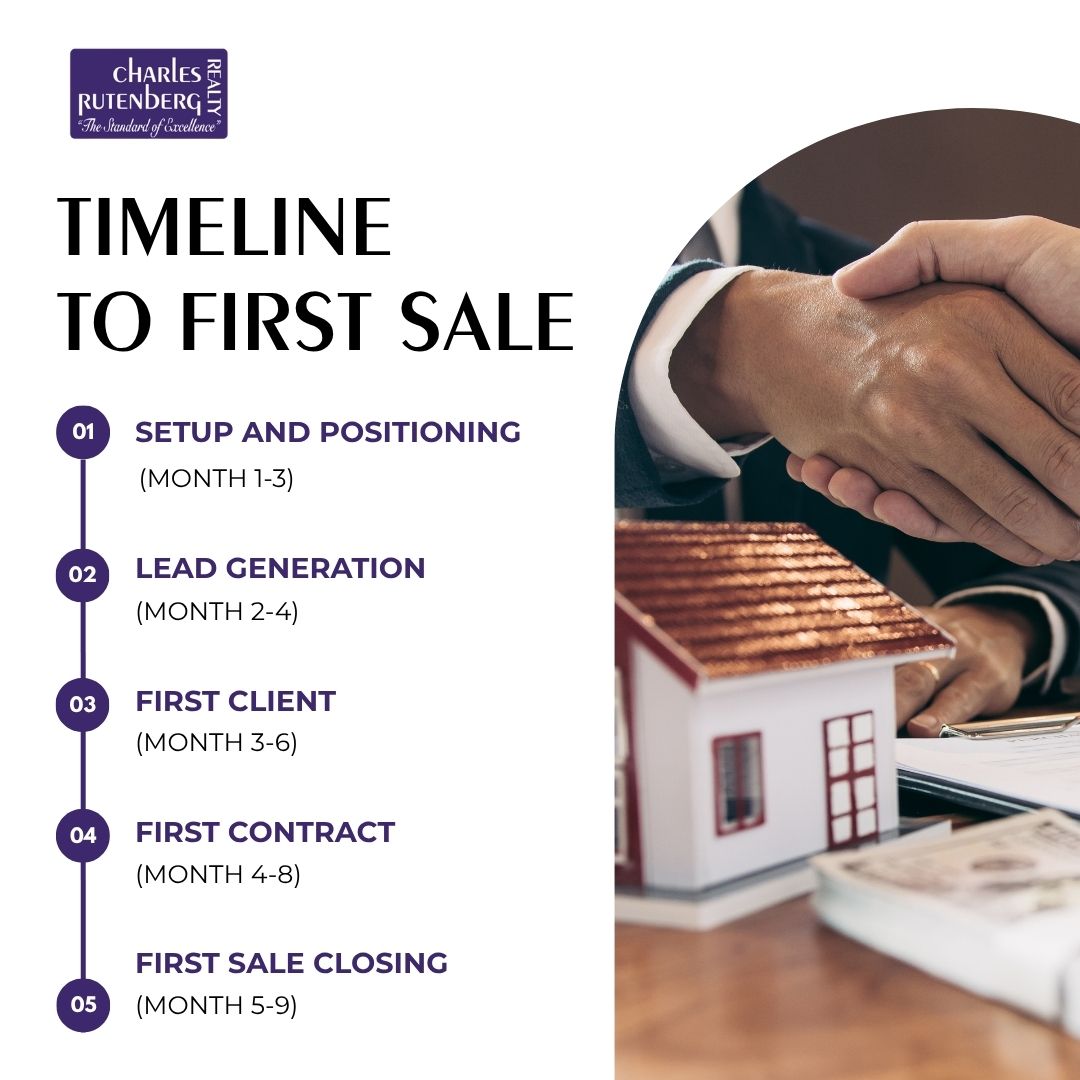
Timeline to First Sale
The licensing timeline is only part of the picture. Understanding what to expect between receiving your licensing and closing your first sale is equally important. This often catches new agents off guard.
Below is a realistic breakdown of that journey and the milestones worth working toward.
Setup and Positioning (Month 1-3)
The first few months after licensure are foundational. This is the time to define your niche—the type of clients you want to work with and the properties you want to specialize in. The more specific your focus, the easier it becomes to stand out in a competitive market like Orlando.
During this period, the priority is building your professional presence. That means establishing your website, developing a consistent social media strategy, and putting a digital marketing plan in place.
For a deeper look at both areas, review our guides “Marketing for Realtors” and “Digital Marketing for Real Estate Agents.”
Lead Generation (Month 2-4)
With your brand and marketing foundation in place, the focus shifts to active lead generation. Door knocking in targeted neighborhoods, cold calling, and consistent networking are all effective starting points. The more people you meet and stay in touch with, the stronger your pipeline becomes.
The timeline from the first conversation to the closed transaction varies widely. However, every connection you make is a potential future client. Consistency in this phase is what separates agents who build momentum from those who stall after licensure.
For proven strategies to expand your network and fill your pipeline, review our guide “Real Estate Lead Generation Ideas.”
First Client (Month 3-6)
With consistent lead generation and marketing efforts, most new agents find their first client within the first six months. This is where the knowledge from your pre-licensing course meets the reality of an actual transaction. It’s also where the learning accelerates significantly.
Do not hesitate to bring questions to your broker or lean on a mentor during this stage. Working through your first few transactions with experienced guidance is not a sign of weakness. It is how you become a competent, confident agent.
First Contract (Month 4-8)
The timeline from signing a client to having a contract in place depends on market conditions and buyer needs. Most homebuyers spend between four and ten weeks searching before submitting an offer. On the listing side, the median days on market in Orlando currently sits at 54.
Every transaction moves at its own pace. Predicting exactly when an offer will come is not always possible. These figures provide a realistic frame of reference for planning purposes—and for setting expectations with clients early in the process.
First Sale Closing (Month 5-9)
Once an offer is accepted, the transaction moves through its final stages relatively quickly. From acceptance to closing typically takes around 30 days. During this time, home inspections, appraisals, and final lending confirmation are completed.
When the paperwork is signed and the keys change hands, your first transaction officially closes. It is now that the business you have been building begins to produce real results—and commission paychecks.
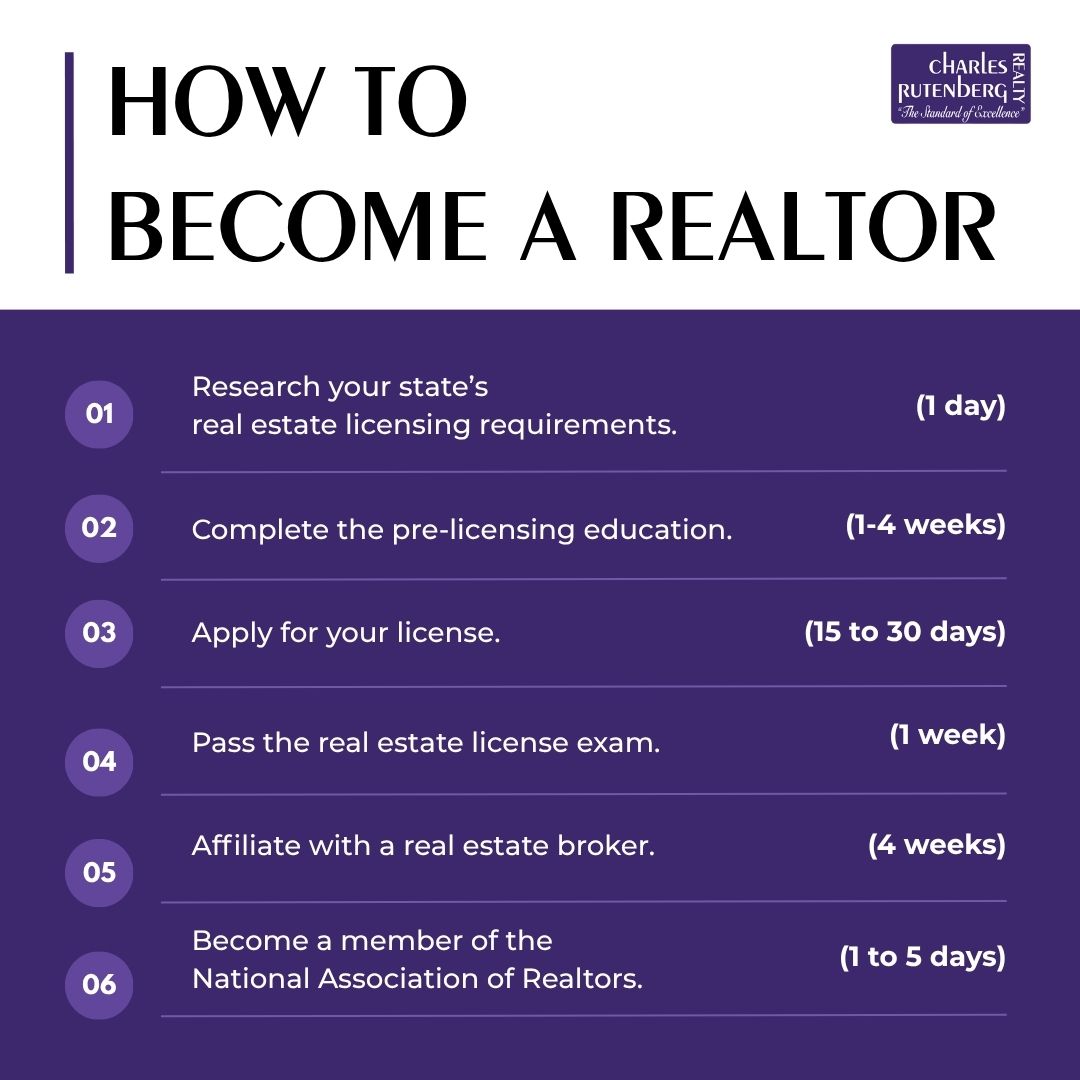
How to Become a Realtor
Research your state’s real estate licensing requirements. (1 day)
Before committing to the path, take time to review Florida’s real estate licensing requirements in full. Confirming you meet the eligibility criteria before starting the process helps you move through each step smoothly.
Complete the pre-licensing education. (1-4 weeks)
Florida requires all prospective real estate agents to complete a 63-hour pre-licensing course through a state-approved school. These courses are available online or in person, with pricing varying by format.
Self-paced online courses are often the most cost-effective option. They also allow candidates to move through the material faster than in a structured classroom setting. In fact, most can finish the course between one and four weeks.
For a full breakdown of what to expect financially throughout the licensing process, review our guide, “How Much Does It Cost to Get a Realtor License?”
Apply for your license. (15 to 30 days)
Once you’ve completed your pre-licensing course, the next step is submitting your application to the Florida Department of Business and Professional Regulation (DBPR). The application requires a background check and electronic fingerprints submitted through an approved LiveScan provider. Following this, the state review of the application can take up to 30 days. Factoring this window into your overall timeline is important.
Pass the real estate license exam. (1 week)
Once the state has approved your application, you can schedule your licensing exam through Pearson VUE. Advance scheduling is required, and most candidates take an additional week or two to study beforehand.
You will take the exam electronically, which means results are available immediately upon completion. To pass, you must answer at least 75% of the 100 multiple-choice questions correctly. If you do not pass on the first attempt, you can reschedule and retake the exam as needed.
Affiliate with a real estate broker. (4 weeks)
Before you can begin practicing real estate, you must affiliate with a licensed broker. This is one of the most consequential decisions you will make early in your career. It deserves careful consideration—this isn’t a decision to rush.
Not all brokerages are structured the same way. Some offer comprehensive training and mentorship for new agents; others operate with minimal oversight. Commission structures vary significantly as well. Traditional brokerages typically take a percentage split, while others, like Charles Rutenberg Realty Orlando, operate on a 100% commission model.
Take the time to interview multiple brokerages before committing. Understanding what each one offers in terms of support, training, and compensation structure will help you make a confident decision.
For more guidance on navigating this process, review our guide “Real Estate Recruiting.”
Become a member of the National Association of Realtors. (1 to 5 days)
The final step in becoming a Realtor is joining the National Association of Realtors. Membership grants you the right to use the Realtor designation professionally. It also provides access to essential industry tools, including the MLS, as well as networking opportunities and professional development resources.
Become a Realtor in eight weeks and keep 100% of your commission with Charles Rutenberg Realty.
Choosing a career in real estate means stepping into a profession with unlimited income potential and a relatively accessible entry point. The licensing process takes approximately eight weeks to complete from start to finish. That means within two months, you could be affiliated with Charles Rutenberg Realty and build your client base.
Every transaction you close means you keep 100% of your commission. Unlike many brokerages with this model, we provide the guidance and mentorship new agents need.
To learn more about what a career at Charles Rutenberg Realty looks like, schedule a call with our broker today.