Pursuing a career as a real estate agent offers significant opportunities. The income potential is uncapped, the schedule is flexible, and you have the ability to build a business that is entirely your own. It’s no surprise that many professionals are drawn to the industry, especially given how accessible the licensing process can be.
However, accessibility does not automatically mean suitability. Real estate may seem simple to pursue, but achieving long-term success requires skill, discipline, and experience. Before beginning the licensing process, it is wise to carefully evaluate both the advantages and the realities of the profession.
Understanding what daily life as a Realtor truly looks like will help you set realistic expectations. In this guide, we outline the pros and cons of being a Realtor based on real-world experience. By the end, you will have the clarity needed to decide whether real estate aligns with your goals and long-term vision.

Pros and Cons of Being a Realtor: A Full Industry Breakdown
Beginning a career in real estate is very different from stepping into a traditional 9-to-5 position. In this industry, you are in complete control. You decide when you work, how you structure your days, how many clients you take on, and how strongly you grow your business.
At first, that freedom sounds ideal. But freedom also comes with responsibility. No one is inherently handing you leads or guaranteeing a specific salary. Instead, you’re strategically building a brand.
It may surprise you to learn that 75% of agents leave the industry within their first year. Within five years, that number climbs to nearly 87%. Most do not fail due to a lack of opportunity; they leave because they underestimate what entrepreneurship truly requires.
It’s important to understand that you are responsible for startup costs, licensing fees, association dues, marketing expenses, and business systems. You operate independently, with professional guidance from your broker, and if you choose, the National Association of Realtors (NAR).
Real estate offers substantial income potential, but only for those willing to approach it with discipline and a business mindset. If you are seeking minimal effort with guaranteed results, this is not the career you are looking for. However, if you are ready to build something of your own, the opportunity is extraordinary.
Is Being a Realtor Hard?
The truth is, real estate can be difficult, especially if you enter the industry without clear expectations. If you prefer constant direction, structured oversight, and someone assigning your daily tasks, you may find this career challenging.
Real estate rewards self-starters. If you are disciplined, proactive, and comfortable taking ownership of your results, the role becomes more manageable. Your days will center around lead generation, marketing, negotiations, client communication, and transaction management. And most importantly, your income is directly tied to your performance. No closings means no commissions.
There will be slower seasons and setbacks. This is part of entrepreneurship. However, if you approach the profession with a business-owner mindset and a willingness to solve problems rather than avoid them, success becomes possible.

What Does It Take to Be a Realtor?
Education and Licensing
The first step to becoming a Realtor is earning your real estate license in the state where you plan to operate. Licensing requirements vary by state. In Florida, the process is straightforward and clearly defined:
- Complete a 63-hour pre-licensing course through a state-approved real estate school
- Submit fingerprints and pass a background check
- Apply for your real estate salesperson license through the Florida DBPR
- Pass the state licensing exam with a minimum score of 75%
- Affiliate with a licensed real estate broker
- Activate your license with DBPR
Once your license is active, you may join the National Association of Realtors and gain access to essential tools such as the Multiple Listing Service (MLS).
It’s important to understand that this process requires financial investment. Licensing fees, course costs, exam fees, and association dues are part of launching your business. Your willingness to invest in yourself is often the first indicator of long-term success.
For a full breakdown of costs, review our guide, “How Much Does It Cost to Get a Realtor License?”
Professional Skills
As with any profession, real estate requires a specific skill set. Some agents naturally possess these strengths. Others develop them over time. What matters most is your willingness to learn and improve.
Below are the core skills every Realtor must master:
- Sales and Negotiation: You are selling two things—your services and your clients’ properties. Strong negotiation skills protect your client’s interests and directly impact results.
- Communication and Follow-Up: Clear, consistent communication keeps transactions smooth. Strategic follow-up turns conversations into contracts and prospects into long-term clients.
- Marketing and Social Media: A defined marketing strategy and business plan build visibility. Your personal brand should position you as credible, professional, and knowledgeable in your market.
- Local Market Knowledge: Understanding pricing trends, inventory shifts, and neighborhood dynamics establishes authority and builds client trust.
- Time Management: Your schedule is yours to control. Prioritizing income-producing activities over busy work is what separates top producers from everyone else.
You don’t need to start with every skill perfected. But if you are committed to developing them, you put yourself in a strong position to succeed.
Personality Traits
Certain personality traits are strongly associated with success in real estate. While you do not need to be naturally outgoing or possess every quality from day one, developing these traits will make your transition into the industry far smoother.
The most impactful characteristics include:
- Self-Starter Mentality: Real estate requires internal drive. No one will manage your daily activity, so motivation must come from you.
- Comfort with Uncertainty: Income is commission-based and can fluctuate. Being mentally prepared for variable income reduces stress and improves decision-making.
- Strong Networking Ability: Confidence in initiating conversations and introducing yourself as a real estate professional is essential. Strong relationships are the foundation of lead generation.
- Resilience After Rejection: Not every prospect will convert. The ability to handle rejection without taking it personally allows you to continue prospecting with confidence.
Evaluating these traits honestly will help you determine whether you are prepared for the demands—and the rewards—of building a successful real estate career.
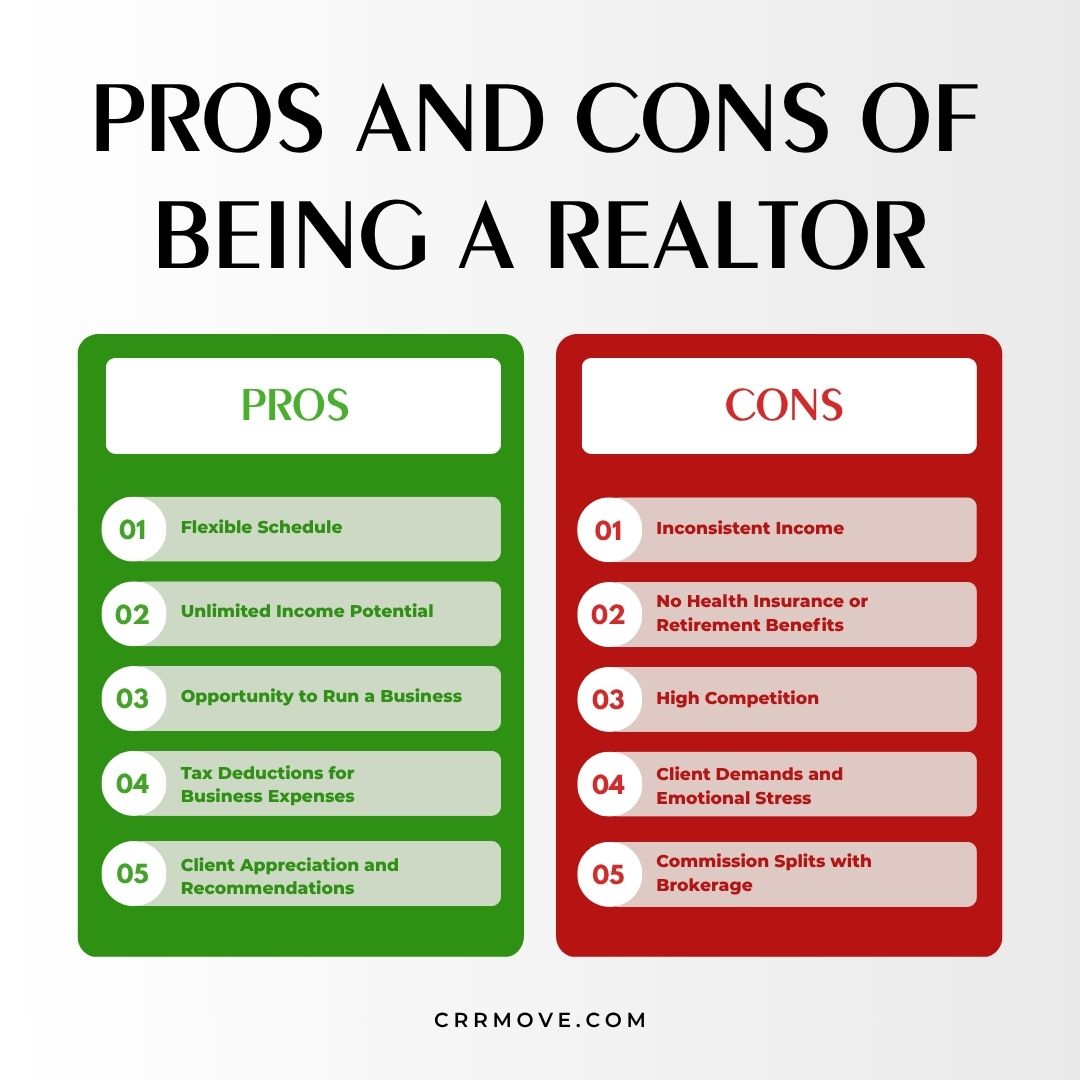
Pros of Being a Realtor
Flexible Schedule
One of the most attractive aspects of a real estate career is flexibility. As a Realtor, you control your schedule and decide when you work and how you structure your day.
This autonomy is especially appealing to parents, caregivers, and professionals with other commitments. You may choose to work early mornings, evenings, or weekends—times that often align well with client availability and open houses. However, flexibility should not be confused with minimal effort. Success still requires structure and consistency.
If you are evaluating how many hours are truly required, review our guide, “Can You Be a Part-Time Real Estate Agent and Still Succeed?”
Unlimited Income Potential
There is no income ceiling in real estate. Your earnings are a direct result of the transactions you close and the commission you negotiate.
Simply put, the more buyers and sellers you successfully represent, the greater your earning potential. Your income is a reflection of your activity, consistency, and performance—not a fixed salary or hourly wage. For driven professionals, this unlimited upside is one of the industry’s most compelling advantages.
Opportunity to Run a Business
If you have ever envisioned owning your own business, real estate provides that opportunity. You get to build your personal brand, define your niche, and determine the direction of your growth.
At the same time, you are not operating entirely alone. The right brokerage offers structure, guidance, training, and operational support to help you navigate the industry effectively. It is the advantage of entrepreneurship, but with the benefit of an established support system behind you.
Tax Deductions for Business Expenses
Operating as an independent contractor in real estate provides certain financial advantages. As a business owner, you may deduct qualified business expenses, including association dues, licensing fees, transaction software, marketing costs, open house materials, and other operational tools.
This structure gives you greater control over how you manage your income. When approached strategically—and in consultation with a qualified tax professional—it can allow you to optimize profitability while building long-term wealth.
Client Appreciation and Recommendations
Many Realtors find deep satisfaction in guiding buyers and sellers through one of the most significant decisions of their lives. Buying or selling a home is often tied to major life transitions—growing families, career moves, downsizing, or new beginnings. Serving as a steady, knowledgeable presence during that process brings a strong sense of professional fulfillment.
When clients feel supported and confident throughout their transaction, their appreciation is tangible. That trust not only strengthens relationships but often leads to referrals and repeat business. In real estate, meaningful service and long-term success frequently go hand in hand.
Learn how to leverage satisfied clients in our guide, “How to Use Client Testimonials to Enhance Realtor Brand.”
Cons of Being a Realtor
Inconsistent Income
Pursuing a career in real estate means accepting income variability. Unlike traditional salaried roles, you do not receive hourly or monthly payments. Your earnings are commission-based and tied directly to closed transactions.
The prospecting, marketing, showings, negotiations, and follow-ups you complete today are investments in future closings. Compensation comes at the end of the process, not along the way.
Some months may be exceptionally strong. Others may be quieter. Setting that expectation early is critical. If you are uncomfortable with fluctuating income, this structure can feel challenging. However, for those who plan strategically and manage cash flow wisely, commission-based income can also create significant upside.
No Health Insurance or Retirement Benefits
Because Realtors operate as independent contractors, they do not receive traditional employer-sponsored benefits such as health insurance or retirement plans. Instead, you are responsible for securing your own coverage and contributing to retirement accounts independently.
For those who join the NAR, there are access points to private health insurance options offered specifically to Realtors. These resources can help offset some of the challenges associated with independent contractor status.
High Competition
Standing out in the real estate industry requires intention and consistency. In Florida alone, there are more than 220,000 licensed agents. That level of competition means visibility is not automatic; it must be earned.
Breaking through requires more than holding a license. It demands a clearly defined personal brand, consistent marketing, and purposeful networking. It is not impossible to rise above the noise. However, it does require a long-term commitment to building recognition in your market.
Client Demands and Emotional Stress
In real estate, client communication does not always occur during convenient business hours. It is not uncommon to receive an urgent text or call from a client who feels stressed about their transaction. That reaction is understandable—buying or selling a home is a significant financial and emotional decision.
Operating in a client-facing role means managing expectations, responding professionally under pressure, and maintaining composure. Success in the industry requires both transactional skills and emotional intelligence.
Commission Splits with Brokerage
It is true that Realtors receive compensation through commission on their closed transactions. However, in many brokerages, that commission is shared through a split structure. The percentage retained by the broker varies and may include sliding scales or production thresholds. For some agents, this can feel disproportionate to the effort required to secure and manage each transaction.
There is an alternative structure, though. At Charles Rutenberg Realty Orlando, we operate on a 100% commission model. Our agents do not split their commission with the brokerage. Instead, there is a flat transaction and administrative fee—never a percentage-based split.
This model allows you to retain more of your earnings and reinvest directly into marketing, systems, and long-term business growth.
Is Being a Realtor Worth It?
If you are driven, disciplined, and motivated by unlimited income potential, a career as a Realtor can be exceptionally rewarding. Real estate offers the authority to build your own business, define your niche, and control your business growth.
That said, the industry is not suited for everyone. Success requires resilience, consistency, and a genuine commitment to entrepreneurship. Evaluating whether you possess—or are willing to develop—those qualities is essential before entering the industry.
How Much Do Realtors Make?
The median annual income for real estate agents is approximately $56,000. However, agents who choose to become Realtors often report earning 15% to 25% more than unaffiliated agents.
It is important to set realistic expectations for your first year. As you build your client base, establish referral relationships, and develop consistent lead generation systems, your income may initially be lower.
That said, long-term earning potential can be substantial. Approximately 62% of Realtors report earning between $75,000 and $200,000 annually. At the upper tier, elite and luxury-focused agents can exceed $500,000 in gross commission. This further proves that in this industry, income growth reflects consistency, strategy, and market positioning.
Start your Realtor career with Charles Rutenberg Realty and keep 100% of what you earn.
Carefully weighing the pros and cons of becoming a Realtor is one of the most important steps before entering the industry. If the realities of commission-based income, competition, and entrepreneurship do not deter you, real estate can be both financially rewarding and professionally fulfilling.
Equally important in pursuing a real estate career is the brokerage you choose. The right environment can accelerate your learning curve and strengthen your foundation from day one.
At Charles Rutenberg Realty, new agents receive structured guidance, professional support, and access to proven tools designed to help them grow. In addition, our 100% commission model ensures you retain more of what you earn—giving you greater flexibility to reinvest in your business.
If you are ready to explore your future as a Realtor, schedule a call and discover how Charles Rutenberg Realty can support your career.