



Building a real estate business in Orlando is more than transactional skill—lead generation and client acquisition are important ongoing responsibilities. While digital marketing has become a standard part of most real estate agents’ strategies, one traditional method continues to produce results: door knocking.
What door–knocking offers that online advertising and social media cannot is a direct, personal connection. A face-to-face conversation with a homeowner carries a different weight than a sponsored post or a targeted email. A few focused hours each week, knocking on doors in the right neighborhoods, can build relationships that convert into listings.
In this guide, we cover what makes door–knocking effective for real estate agents in Orlando. We also share practical tips for getting the most out of each conversation and outline how to build a script that opens doors. Ultimately, blending both traditional and modern approaches can build your pipeline and generate more offers.
Realtor Door Knocking Tips to Get More Listings
Door knocking offers something most lead generation methods cannot—a direct, in-person connection. Face-to-face conversations build trust more quickly than digital outreach. Moreover, consistent presence in a neighborhood establishes you as a local resource rather than just another Realtor sending mailers.
It also surfaces opportunities that would never appear through online channels alone. A homeowner quietly considering a sale or a neighbor watching the market are both conversations that happen at the door—not through the screen.
That said, door–knocking requires patience, practice, and genuine conversational skills. Even experienced agents can find it uncomfortable at first. The tips in this guide are designed to help you approach each door with confidence and move past the initial introduction.
What Is Door Knocking in Real Estate?
Door–knocking in real estate is the practice of canvassing targeted neighborhoods in person to prospect for leads and build client relationships with homeowners. It is one of the most direct ways for agents to introduce themselves and establish a local presence. Moreover, they can identify potential buyers and sellers before actively seeking representation.
Through these conversations, agents can share relevant market updates, gauge homeowner interest, and add qualified prospects to their pipeline. When combined with a consistent digital marketing strategy, door knocking accelerates the process of building trust and local authority.
Is Door Knocking Effective for Realtors?
Door knocking can be a highly effective lead generation method when approached with the right strategy. Agents who commit to it consistently report a conversion rate of roughly 2% to 3%. That means for every 100 doors knocked, two or three meaningful client relationships can develop. At its core, it is a numbers game.
That said, volume alone is not enough. A well-prepared script, strong conversational skills, and a structured follow-up strategy are just as important as the number of doors you approach. The agents who see the best results combine consistent effort with genuine skill.
Door knocking tends to perform best in neighborhoods with recent sales or in areas where you are intentionally building a local reputation. Wherever your focus lies, adding it to your lead generation mix is worth serious consideration.
What Is the Best Time to Door Knock for Realtors?
Timing plays a significant role in the success of door knocking. According to the National Association of Realtors, the most effective window is between 10 am and 11:30 am. This is when many homeowners are home and more receptive to an unexpected conversation.
Late afternoon on weekdays can also work well, catching homeowners before or after work hours. On weekends, late morning to early afternoon tends to produce the best results.
Not every door will open, and not every conversation will lead somewhere immediately. That is one part of the process. The discipline lies in showing up consistently. The homeowner who eventually lists with you may be the one who opens the door on an otherwise quiet morning.
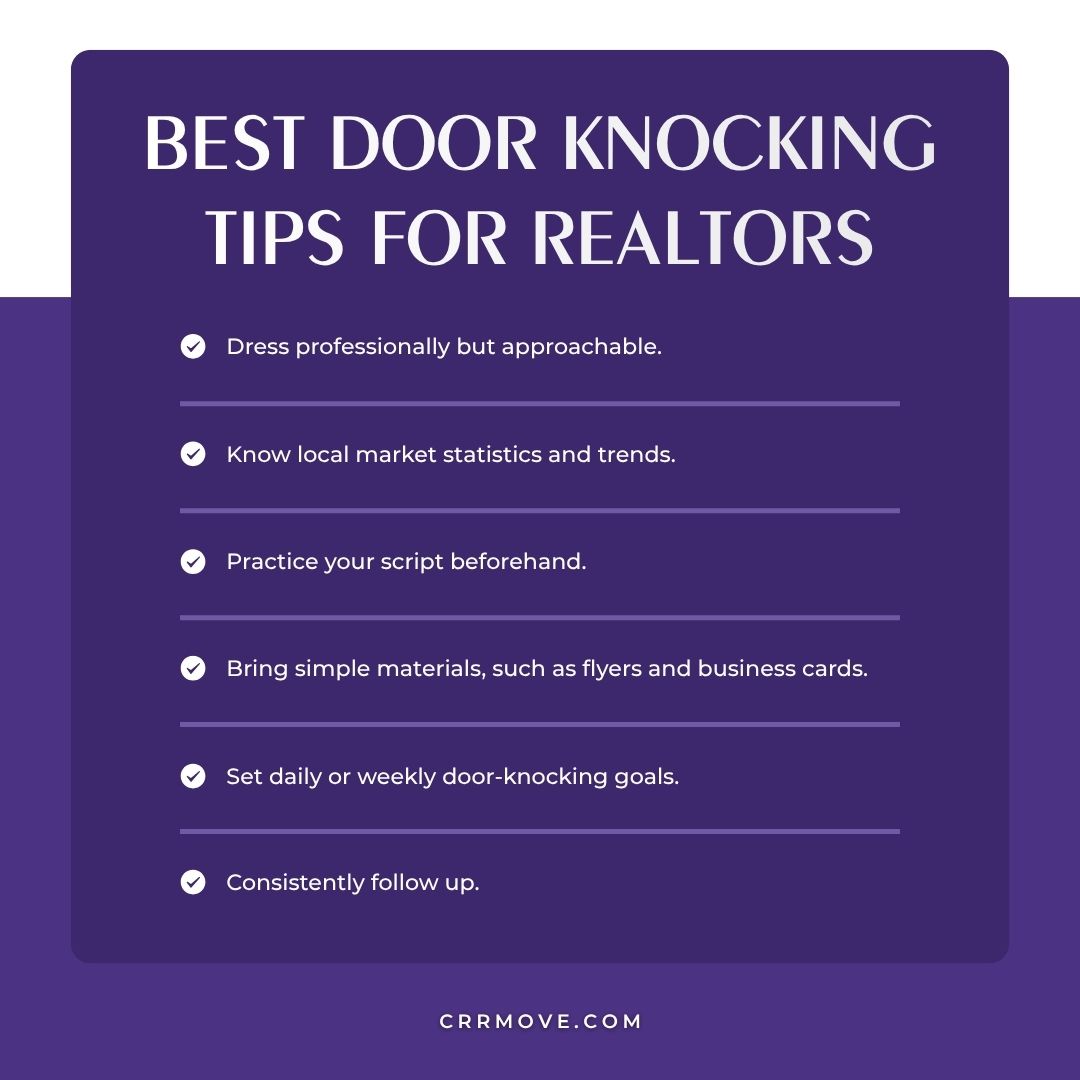
Best Door Knocking Tips for Realtors
Dress professionally but approachable.
First impressions form quickly at the door, and appearance is a significant part of that. Dressing professionally but approachable signals credibility without creating distance. This matters when you are introducing yourself to a stranger on their doorstep.
In Orlando’s warm and humid climate, that does not always mean a suit. Clean, polished, and contextually appropriate is the standard to aim for. When your appearance feels consistent with the neighborhood you are working in, it naturally reduces any initial hesitation. Therefore, it makes it easier for homeowners to engage with you.
Know local market statistics and trends.
Showing up without something of value to offer is a missed opportunity. The most effective door knockers come prepared with relevant, local information. This could include recent sales data, market trends, details on nearby open houses, or insights into how home values have shifted.
When you speak specifically to what is happening in the area, you stop being a stranger and become a resource.
Practice your script beforehand.
A well-prepared door–knocking script is one of the most effective ways to build confidence and hold meaningful conversations. Practice it before heading out, but remember that the goal isn’t to make it sound rehearsed. Instead, practice it to ensure you can deliver it naturally and adapt when the conversation shifts.
Most importantly, know how you will respond to common objections and what value you are offering before you knock. The difference between a productive door–knocking session and an unproductive one often comes down to the agent’s preparation.
Bring simple materials, such as flyers and business cards.
Every door–knocking visit should end with something left behind. A one-page market update and a business card give homeowners a reason to reach back out. It’s also a way to remember the conversation when the time is right.
For doors that do not open, a well-designed door hanger serves the same purpose. Include relevant local market information and clear contact details. A homeowner who was not home that day can still become a future client. However, this depends on whether you give them a way to find you.
Set daily or weekly door-knocking goals.
Door knocking is not a one-time tactic. It is a habit. The agents who see consistent results from it commit to a regular schedule. That could mean going out twice a week or setting a target number of doors per session.
The more homeowners you meet and follow up with over time, the stronger your pipeline becomes. Consistency is what separates agents who occasionally knock on doors from those who build their business through it.
Consistently follow up.
A single conversation at the door rarely produces a client on the spot. What it does is open the relationship. The follow-up is where the work happens.
Add contacts to your email list, share relevant market updates, and invite homeowners to connect when they’re ready to discuss their goals. Consistent, low-pressure communication over time keeps you top of mind. So, when a homeowner decides to sell, you are the first agent they think of.
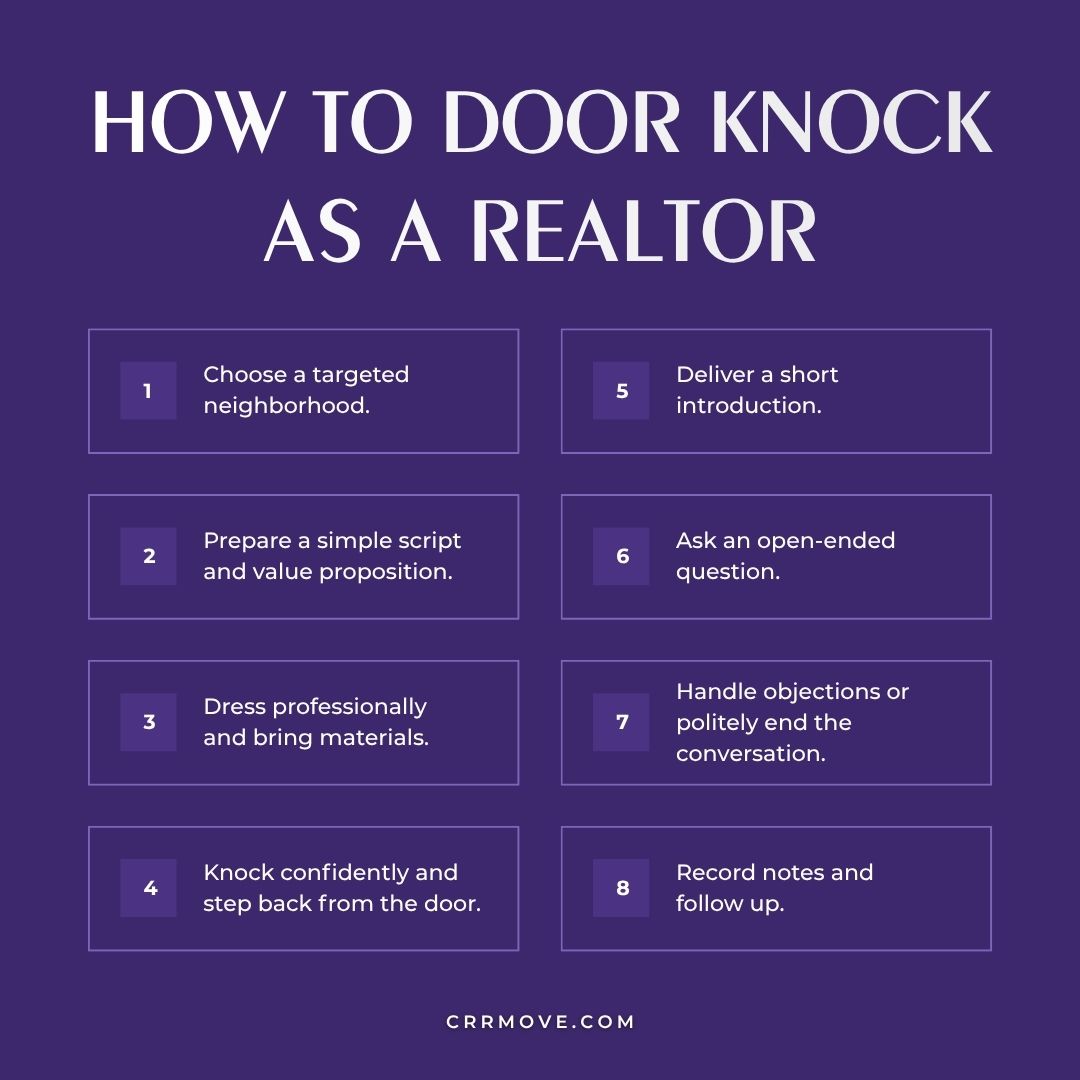
How to Door Knock as a Realtor
Choose a targeted neighborhood.
Choosing the right neighborhood before heading out makes a meaningful difference in the quality of your conversations. Focus on areas with recent sales activity, rising home values, or markets where you are actively building your presence. The more relevant your information is to that specific area, the more value you bring to each door.
Looking for additional ways to establish yourself as the go-to expert in a specific market? Review our guide “How to Become a Local Real Estate Market Expert.”
Prepare a simple script and value proposition.
A prepared script with a clear value proposition gives your conversations direction and purpose. Confidence follows naturally when you know how to open the conversation and what you want to leave behind.
In this circumstance, practice matters. The more familiar you are with your script, the more natural it sounds. That means you can more easily adapt when the conversation takes an unexpected turn.
Dress professionally and bring materials.
Presentation matters before a single word is spoken. Arriving at someone’s door looking polished and professional signals that you take your role seriously. As a result, it can directly influence whether a stranger is willing to give you their time.
Your materials deserve the same attention. Review everything you plan to leave behind for clarity, accuracy, and readability. Check for errors, confirm your contact information is displayed, and ensure the content is useful to homeowners. What you leave at the door is often what they refer back to when they decide to reach out.
Knock confidently and step back from the door.
Confidence is one of the most important tools you bring to the door. Homeowners make quick judgments, and an agent who approaches with certainty and ease is seen as credible and trustworthy. And that’s before the conversation even begins.
Knock with intention, step back slightly as you wait, and meet whoever answers with a genuine smile and a composed introduction. How you carry yourself in those first few seconds sets the tone for everything that follows.
Deliver a short introduction.
The opening seconds of a door–knocking conversation carry more weight than any other part of the interaction. Your introduction needs to establish who you are, why you are there, and what value you bring. This happens all within the first few sentences.
Keep it clear, friendly, and natural. A strong introduction does not feel like a pitch. It feels like the beginning of a conversation worth having.
Ask an open-ended question.
Open-ended questions are among the most effective tools for keeping a door-knocking conversation moving. A question that requires more than a yes–or–no invites the homeowner to engage. They can share their perspective and also see you as someone worth talking to.
It’s important to use open-ended questions early. A simple opener like “How are you enjoying the neighborhood?” can start a conversation without putting pressure on the other person. More specific questions—such as references to something happening in the area—demonstrate local knowledge and provide a natural reason to keep talking.
Handle objections or politely end the conversation.
Handling objections gracefully is a skill that develops with practice. The ability to acknowledge a homeowner’s hesitation without losing the thread of the conversation is what keeps doors open.
Equally important is knowing when to step back. Not every homeowner will be receptive, and pressing a conversation past its natural endpoint does more harm than good. Recognizing that moment and closing with professionalism leaves a better impression than overstaying your welcome. This is the impression you want to leave them with if they eventually decide to sell.
Record notes and follow up.
After each conversation, take a moment to note the key details. Write down what you discussed, the homeowner’s situation, and any follow-up they agreed upon. Getting that information into your CRM promptly prevents you from missing any details.
Moreover, it gives you the context needed to make your next outreach feel personal rather than generic. Referencing details from your last conversation in your follow-up is a small detail that strengthens the relationship.
As your door–knocking activity grows, managing follow-ups manually becomes increasingly difficult. Many agents use automated tools to stay consistent without adding hours to their week. For a breakdown of the most useful options, review our guide “Technology for Real Estate Agents.”
Door Knocking Scripts for Realtors
Building a door–knocking script takes practice. But once you understand how effective conversations are structured, it becomes easier to execute with confidence.
Every strong door–knocking script follows a clear framework:
- Pattern interrupt opening: Start with something that immediately lowers the homeowner’s guard. “Hey, I’m not here to sell you anything…” signals that this is a different kind of conversation.
- Identify yourself: State your name and brokerage clearly and early. Credibility is established in seconds.
- State a hyper-local reason: Reference a recent sale, a new listing, or a market shift on their specific street. Specificity demonstrates that you know the area.
- Ask a soft, open-ended question: Keep the tone conversational rather than transactional.
Framing your script with the following opening lines can engage the homeowner and keep the conversation flowing:
- Just Sold: “Hey, I’m [NAME] with [BROKERAGE]. We just sold a home nearby, and a few buyers missed out. Would you consider selling if the price made sense?”
- Market Update: “Quick question—have you been keeping an eye on how prices have been moving in this neighborhood?”
- Buyer in Hand: “This might sound random, but I actually have a buyer looking specifically in this area…”
- Curiosity Hook: “If you knew you could sell your home for top dollar in the next 60 days, would you at least want to know what that number looks like?”
Each of these works because it opens a door rather than closes a sale. The goal of the first conversation is a second conversation—not a signed listing agreement.
For a step-by-step guide on how to write a winning script, review our guide: “Door Knocking Script for Realtors.”
Keep 100% of your commission from clients you meet door–knocking with Charles Rutenberg Realty.
Door knocking may be one of the oldest lead generation strategies in real estate. However, in a market where most agents have shifted their focus to digital channels, in-person presence is a genuine differentiator. A well-prepared script, a professional presence, and the ability to handle objections are the foundation. Consistent weekly effort in targeted neighborhoods is what builds results over time.
And when that effort converts into a closed transaction, Charles Rutenberg Realty Orlando ensures you keep 100% of your commission. No brokerage splits—ever. You get the support of an established brokerage without giving up what you earned.
To learn more about what a career at Charles Rutenberg Realty looks like, schedule a meeting with our broker today.