Real estate continues to attract professionals looking for flexibility, unlimited income potential, and the opportunity to run a business. It is one of the few industries with an accessible entry point, as it doesn’t require a college degree and offers a clearly defined licensing process.
However, real estate requires focused, state-approved education. The pre-licensing curriculum goes well beyond the basics of buying and selling properties. It also covers real estate contracts, negotiation principles, market data interpretation, and the legal and ethical responsibilities agents carry.
If you are considering a career in real estate, understanding the education requirements is the right place to start. This guide outlines what you will need to learn, what the coursework covers, and where to start. By the end, you will have a clear picture of what becoming a licensed real estate professional in Orlando, Florida, actually involves.
What Education Is Needed to Be a Real Estate Agent?
Before practicing real estate, every agent must complete a state-approved pre-licensing course and pass the licensing exam. However, it’s important not to approach the coursework solely as exam preparation. The goal isn’t to simply pass an exam—it’s to gain the fundamental knowledge necessary for success.
Agents who build sustainable careers in real estate treat pre-licensing education as the foundation it should be. Understanding industry law, ethical responsibilities, financial principles, and state-specific regulations is what allows agents to serve clients competently.
More specifically, passing the exam gets you licensed; understanding the material makes you effective.
Do You Need an Education to Be a Real Estate Agent?
Before becoming a licensed real estate agent, you must meet two educational requirements. The first is a high school diploma or equivalent GED. The second is a state-approved real estate pre-licensing course.
Real estate course requirements vary by state. In Florida, aspiring real estate sales agents must complete a 63-hour pre-licensing course through a state-approved school. The real estate course is available online or in person. However, the format you choose will depend on your schedule, preferred learning style, and budget.
The curriculum covers the foundational principles every agent needs to understand before entering the field. It also serves as the basis for what the state licensing exam actually tests.
Do you want more information about how much you can expect to spend on the pre-licensing course? Review our guide “How Much Does It Cost to Get a Realtor License?”
Do You Need a Degree to Be a Real Estate Agent?
Most states do not require a college degree to become a real estate agent. In fact, many real estate agents, including those coming from unrelated fields, enter the industry without a traditional business or finance background.
That said, certain academic backgrounds and degree programs can provide a meaningful advantage. Degrees in marketing, finance, and business can translate directly into the real estate industry. And in sectors such as client acquisition, financial planning, and business operations, pre-existing knowledge can significantly benefit future agents.
Do you want a closer look at which educational backgrounds complement a real estate career? Review our guide “What Degree Do You Need to Be a Realtor?”
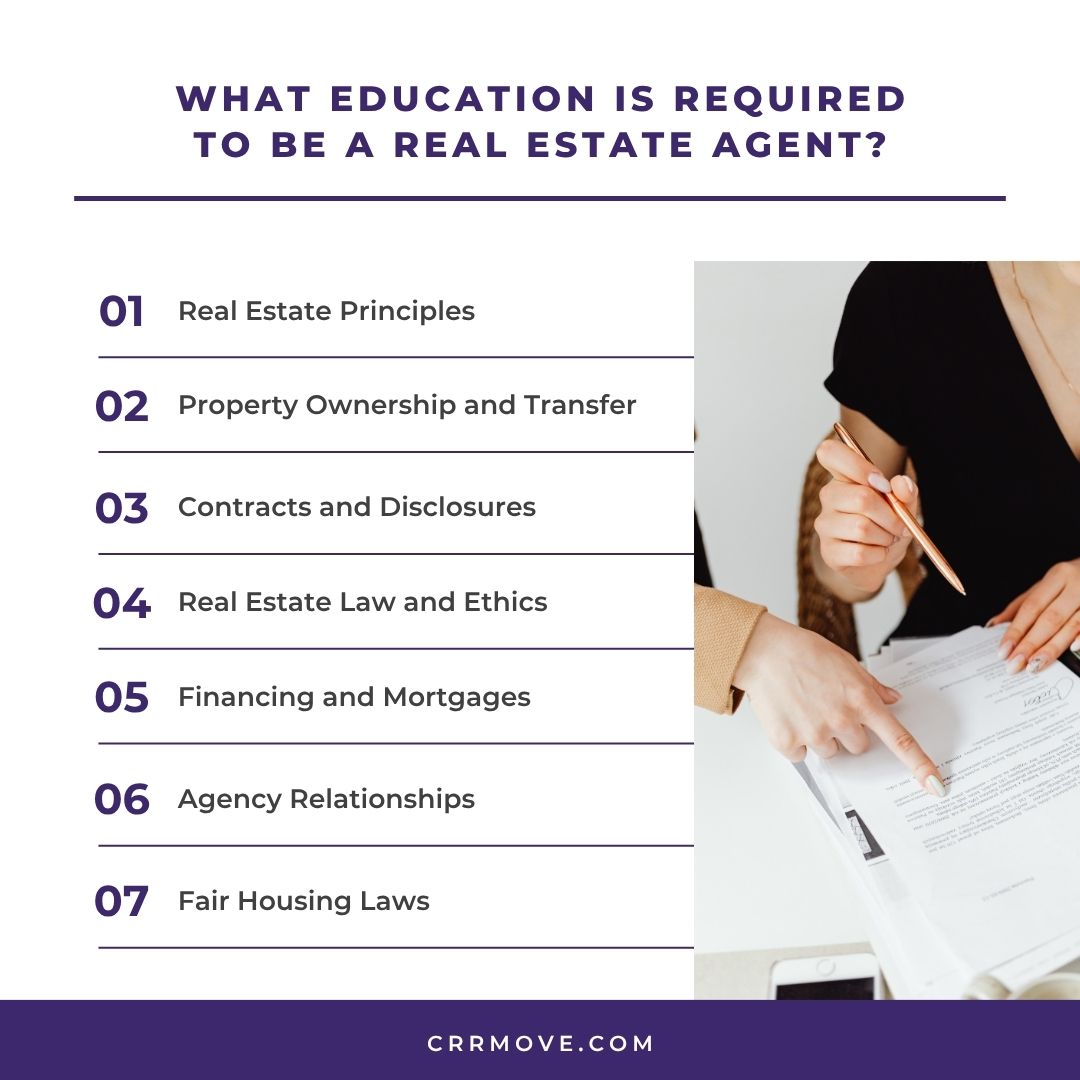
What Education Is Required to Be a Real Estate Agent?
The required pre-licensing course covers a range of topics that form the foundation of your work as a licensed agent. It covers facilitating transactions, working with clients, and providing informed professional guidance. Ultimately, the curriculum prepares you for the practical realities of the role.
Real Estate Principles
Real estate principles form the foundation of the entire pre-licensing curriculum. It explains how the industry operates, defines the roles of agents and brokers, and covers transaction structure. You will build a working vocabulary, develop an understanding of core market concepts, and learn the mechanics to eventually buy and sell properties. The remaining coursework builds on this framework.
Property Ownership and Transfer
Property ownership and transfer focus on the different forms of property ownership. These include sole ownership, joint tenancy, and tenancy in common. It also explains how ownership legally transfers between parties, which is crucial knowledge for agents.
You will study the role of deeds, title searches, and title insurance in the transfer process. A clear understanding of these distinctions is essential for guiding clients through closings with accuracy and confidence.
Contracts and Disclosures
Contracts and disclosure are necessary educational topics for real estate professionals. You must understand how to form legally binding contracts and what elements make them enforceable. Additionally, you will learn how to handle amendments or cancellations when circumstances change.
Disclosure requirements are of equal importance. Florida law obligates both sellers and agents to disclose known material defects, and failure to do so carries real legal consequences. More specifically, errors in either area can expose you and your clients to significant liability. Therefore, this is one of the most practically important topics of the curriculum.
Real Estate Law and Ethics
During the course, you will learn the legal framework governing real estate practice in your state. This includes the statutes and regulations that define what agents can and cannot do. In Florida, the Florida Real Estate Commission (FREC) administers these rules, which set the standards all licensees must meet.
Alongside laws, the course covers professional ethics. This is not a formality—ethical violations can result in license suspension or revocation. Understanding both the letter and the spirit of the standards you commit to is essential when entering the profession.
Financing and Mortgages
Understanding the financial mechanics behind real estate transactions is necessary for real estate professionals. This includes how lenders structure mortgage loans, which loan types exist, and how interest rates influence purchasing power.
For agents, this knowledge pays dividends in daily practice. Buyers frequently ask whether they can afford a specific property or how a rate change affects their monthly payment. Agents who speak to these concepts with confidence guide clients through financial decisions more effectively. Moreover, they can set realistic expectations early in the process and work more effectively with lenders to keep transactions moving forward.
Agency Relationships
Agents need a clear comprehension of the legal relationship between themselves and the party they represent. You will learn the duties owed to clients versus customers, as well as the different agent types. These include single agency, transaction brokerage, and no brokerage. Additionally, those in Florida will learn specific disclosure requirements surrounding those relationships.
Understanding agency correctly from the outset of every transaction is not a technicality. It is a foundational protection for both you and the clients you represent. Mishandling agency relationships is one of the more common sources of legal exposure for agents. Fortunately, the pre-licensing curriculum addresses it in the detail it deserves.
Fair Housing Laws
Real estate education also covers federal and state laws prohibiting discrimination in the sale, rental, and financing of housing. You will learn which classes the law protects and what constitutes a violation. Moreover, this understanding will ensure your marketing materials and client interactions remain fully compliant.
Agents who study fair housing laws are not simply reducing legal exposure. They are building a practice grounded in equal access and professional integrity. In a diverse market like Florida, that foundation matters every day.
For more insights, read our guide, “How to Get Your Real Estate License.”
How Much Continuing Education Is Required for Real Estate Agents?
The education requirement does not end once you receive your license and affiliate with a real estate broker. Every licensed agent must complete continuing education on an ongoing basis. That means a 14-hour course every two years covering updates to laws, ethical standards, and industry regulations. Completing this coursework is necessary to renew your license and maintain an active status.
Florida, in particular, requires newly licensed agents to complete a 45-hour post-licensing course within 18 to 24 months. This coursework goes beyond the fundamentals of the pre-licensing curriculum. Instead, it addresses the more advanced, practical aspects of daily real estate practice, confidently bridging the gap between passing the exam and operating in the field.
Are you looking for a timeline breakdown to become a licensed agent? Read our guide “How Long Does It Take to Get a Real Estate License?”
Start your career in real estate with Charles Rutenberg Realty and keep 100% of your commission.
A real estate career does not require a college degree, but it does require a commitment to education—both before and after licensure. The pre-licensing coursework builds the foundation you need to pass the state exam. From there, continuing education and hands-on experience ensure that learning remains an ongoing part of the career.
Starting that career with the right brokerage makes a meaningful difference. At Charles Rutenberg Realty Orlando, new agents receive the resources, training, and support to find their footing from day one. And with our 100% commission model, you keep more of what you earn on every transaction—no splits, ever.
Are you ready to take the first step? Schedule a call with our broker to discuss how Charles Rutenberg Realty can support your career in real estate.