One of the most compelling aspects of becoming a Realtor in Florida is the unlimited income potential. Florida is a market where people consistently relocate for retirement, second homes, or a change in lifestyle. Knowing this, the opportunity for agents who build their own businesses is significant. Before pursuing a real estate license, however, understanding what Realtors in Florida actually earn provides a realistic foundation for the decision.
While real estate is one of the few career paths with no ceiling on earning potential, that potential comes with effort. More specifically, commission income varies considerably depending on location, brokerage structure, experience level, and current market conditions. Understanding those variables in advance helps set expectations that are grounded in reality rather than assumptions.
This guide covers what Realtors in Florida can expect to earn and how real estate commissions work. We will also outline the day-to-day responsibilities of the role in relation to that income. Additionally, we provide earnings by experience level and guidance on how to begin the licensing process. With this foundational knowledge, it’s significantly easier to build a thriving, successful career.
How Much Do Realtors Make in Florida? Real Income Numbers
For professionals who want genuine control over their income, becoming a Realtor in Florida is worth serious consideration. High-demand markets like Orlando and its surrounding suburbs offer real opportunities for agents. Nonetheless, entering the career with realistic expectations about commission income sets the foundation for long-term success—including how it works and what it takes to earn it.
Income growth in real estate is rarely immediate. The financial rewards tend to follow consistent effort over time, not the other way around. For agents who stay dedicated through the early stages, the payoff can be substantial. However, you earn this through sustained work over the years, not immediately from day one.
Is Real Estate a Lucrative Career in Florida?
Florida offers Realtors a genuinely strong opportunity, driven largely by consistent housing demand. With an annual population growth rate of approximately 0.85%, the number of people searching for housing continues to grow. Vacation homes and luxury properties also represent a significant portion of the market. These higher home sale prices translate directly into higher commission amounts per transaction.
It’s important to recognize that income as a Realtor directly correlates to the effort behind it. Market conditions create opportunity. Consistency, marketing, lead generation, and client relationships determine whether that opportunity translates into income.
For a closer look at how Realtor compensation works, review our guide “How Do Realtors Get Paid?”
What Does a Realtor Do in Florida?
Earning commission as a Realtor involves more than helping buyers and sellers through the transaction process. Day-to-day responsibilities typically include:
- Listing and marketing properties
- Scheduling showings and open houses
- Negotiating offers and contracts
- Guiding buyers through every stage of the transaction
- Coordinating inspections and estimating closing costs
- Building relationships with clients and cultivating referrals
- Implementing a consistent lead generation and marketing strategy
- Staying current on market conditions and regulatory changes
Each of these contributes directly to whether a transaction closes successfully. The commission an agent earns reflects the full scope of this work, not just the moment a sale finalizes.
Is Being a Realtor Worth It in Florida?
Being a Realtor in Florida is worthwhile for professionals who want control over their income and the autonomy to run a business. This is particularly the result of a market that provides flexibility and long-term growth potential. However, realizing that potential depends on self-motivation, marketing ability, and the financial discipline to manage fluctuating income from month to month.
The barrier to entry is low, but the role itself requires an entrepreneurial mindset. For those ready to take on that responsibility, the long-term benefits make real estate a strong career move.
For more insights, see our guide, “Is Real Estate a Good Career?”
What Percentage Do Realtors Get in Florida?
The total commission on a home sale typically falls between 5% and 6% of the sale price. That amount is generally split between the listing agent and the buyer’s agent. Following this, each side brings approximately 2.5% to 3% back to their respective brokerage.
With most traditional real estate brokers, there is a second reduction. The brokerage retains a percentage of the agent’s commission—a structure commonly known as a commission split. Additionally, commission rates themselves are negotiable, and experienced agents may command higher rates based on their experience.
Traditionally, the seller pays the full commissions when the home sells, dividing that amount between both brokerages. However, following a recent ruling from the National Association of Realtors (NAR), buyers may now be responsible for their agent’s commission directly.
With this in mind, commission is a significant factor when determining your net income. That’s why at Charles Rutenberg Realty Orlando, we ensure agents keep 100% of their commission, with only flat fees for administrative support and E&O insurance deducted. You can learn about this in our comprehensive guide, “100% Commission Real Estate Brokerage: Charles Rutenberg Realty.”
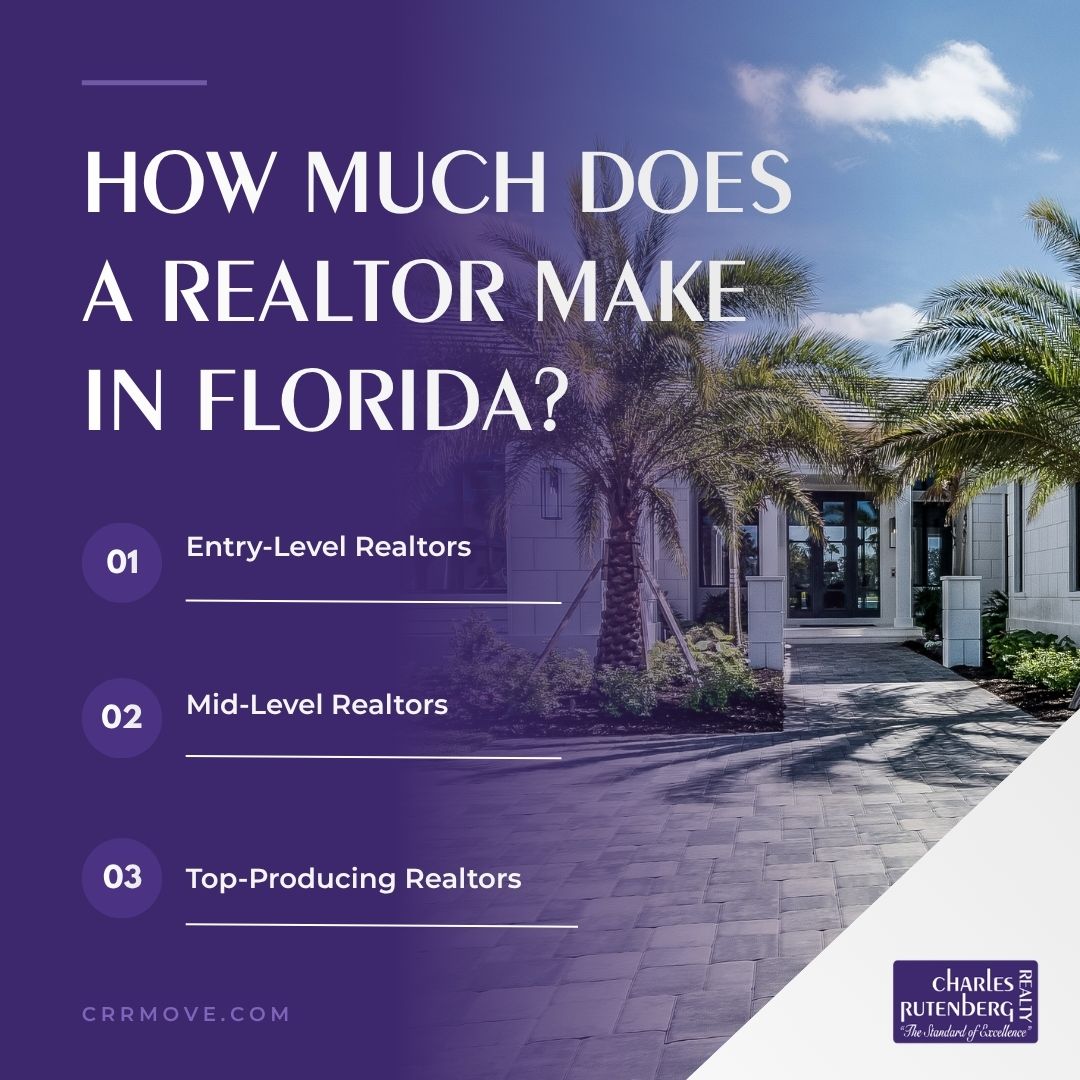
How Much Does a Realtor Make in Florida?
Entry-Level Realtors
As we have noted, building a real estate business takes time, and early-career income reflects that reality. Entry-level real estate agents in Orlando can expect to earn approximately $38,622 per year during their first three years in the profession.
Many new agents begin part-time, using real estate to supplement existing income while they build their business. As transaction volume grows and a steady client base develops, many transition into real estate full-time.
Mid-Level Realtors
Mid-level Realtors earn approximately $100,948 per year in Orlando, Florida. At this stage, transaction closings become more consistent, and referrals begin to play a significant role. Agents report that 82% of their clients come through referrals from previous clients.
By this point, agents have also developed a clearer understanding of how to run their business efficiently. An established client network, combined with refined processes, contributes to income that is not only higher but also more stable annually.
Top-Producing Realtors
While there is no ceiling on earning potential as a Realtor in Florida, top-performing agents often reach $300,000 or more annually. These agents typically focus on luxury listings or maintain strong relationships with repeat clients such as investors. Naturally, these are segments where higher sale prices translate directly into higher commission income.
Many top agents also build teams, earning a percentage of their team members’ commissions in exchange for mentorship and brand support. That structure allows experienced agents to scale their income beyond what individual transactions alone provide.
The brokerage you choose plays a direct role in how much of that income you actually keep. That is part of why so many high-performing agents choose Charles Rutenberg Realty. Our agents retain more of what they earn while still benefiting from the support and resources of a full-service brokerage.
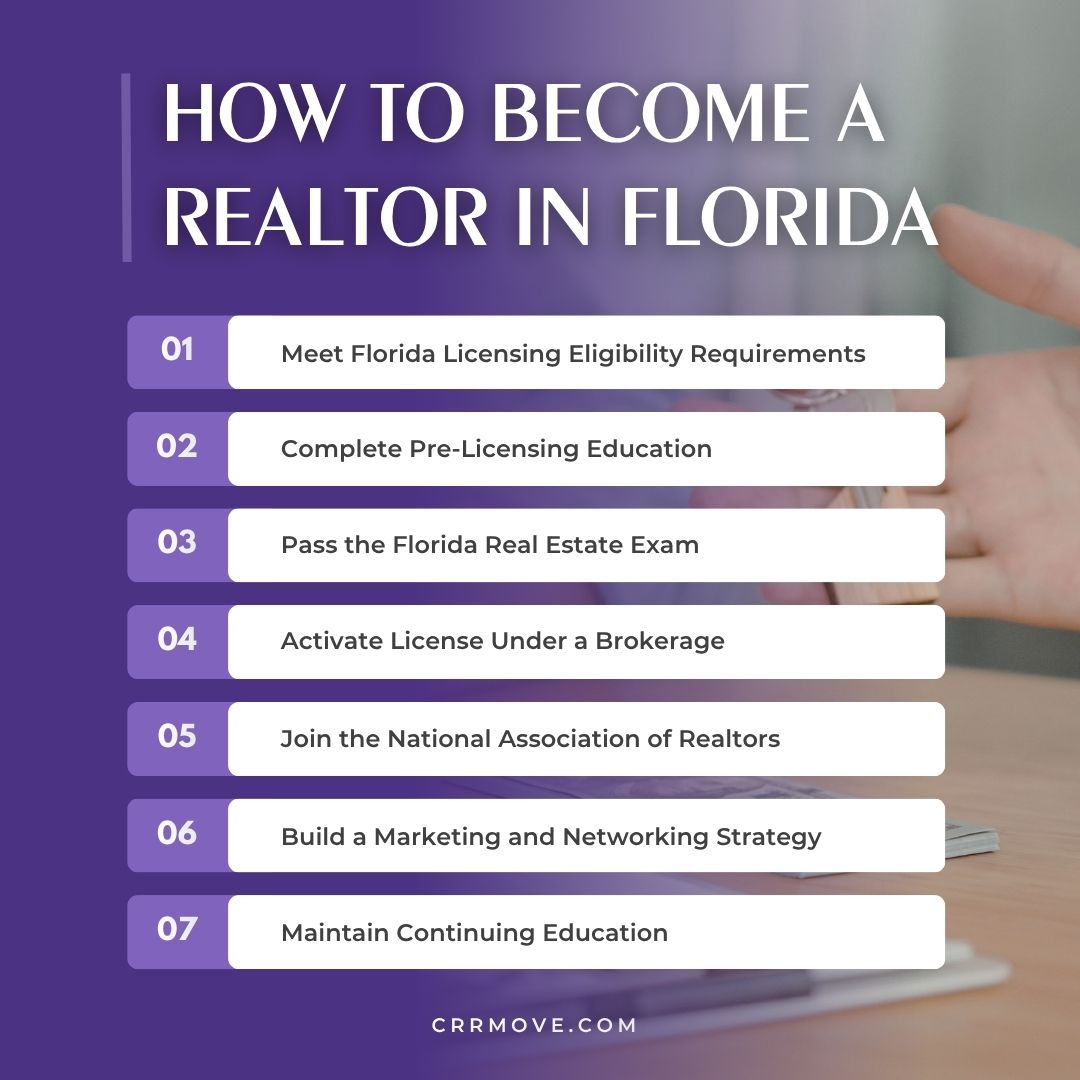
How to Become a Realtor in Florida
Meet Florida Licensing Eligibility Requirements
To become a Realtor in Florida, candidates must meet the following eligibility requirements:
- Be at least 18 years old
- Hold a high school diploma or GED equivalent
- Have a valid U.S. Social Security number
- Pass a background check
If you meet these requirements, then you may proceed with the licensing process.
Complete Pre-Licensing Education
While no degree is required to become a Realtor, completing the state’s mandatory education requirements is non-negotiable. In Florida, this means a 63-hour pre-licensing course through an approved real estate school. The course covers real estate principles, regulations, contract law, and the fundamentals of practice. This coursework forms the foundation for working in the industry and directly prepares you for the state licensing exam.
The course is available online or in person, giving you flexibility based on your timeline, learning style, and budget. For a full breakdown of what to expect financially, review our guide “How Much Does It Cost to Get a Realtor License?”
Pass the Florida Real Estate Exam
After completing your pre-licensing course, you will submit your real estate salesperson application to the Florida Department of Business and Professional Regulation. Application approval makes you eligible to schedule the licensing exam. Pearson VUE administers the exam electronically, consisting of 100 multiple-choice questions. A passing score is 75% or higher, and results appear immediately upon completion.
If you do not pass on the first attempt, you can reschedule and retake the exam as many times as needed.
Activate License Under a Brokerage
Before you can legally practice real estate, you must affiliate with a licensed broker. This decision deserves real consideration, as the brokerage you choose can set the tone for your entire career.
That influence extends from the training and support you receive to the income you ultimately keep. Once you complete the real estate recruiting process and find a broker, they will activate your license so you can begin practicing.
Join the National Association of Realtors
To officially become a Realtor, you must join the National Association of Realtors. Membership requires adherence to a formal Code of Ethics, which holds Realtors to a professional standard beyond basic licensing requirements.
In return, you gain access to a recognized professional network, events, tools, and resources to support your business. Moreover, you can use the Realtor designation in your marketing.
For a closer look, read our guide “What’s the Difference Between a Realtor and a Real Estate Agent?”
Build a Marketing and Networking Strategy
With your license and Realtor designation in place, the focus shifts to building your business. That means developing a marketing strategy, networking with potential clients, and establishing consistent lead generation habits. Momentum takes time, but the foundation you set now shapes how quickly that momentum builds.
For practical marketing strategies, review our guides “Marketing for Realtors” and “Digital Marketing for Realtors.” To explore tools that can help streamline your operations, read our recommendations in “Technology for Real Estate Agents.”
Maintain Continuing Education
Florida requires newly licensed agents to complete a 45-hour post-licensing course within their first 18 months. Beyond that, every agent must complete a 14-hour continuing education course every 2 years to remain in good standing. Failing to complete these requirements can prevent license renewal.
Staying current on regulatory changes and market developments serves a dual purpose. It keeps your license active, and it ensures you continue to serve clients with accurate, up-to-date guidance. Ultimately, this directly supports the growth of your business over time.
Keep more of what you earn as a Realtor in Florida with Charles Rutenberg Realty’s 100% commission model.
Understanding both the income potential and the realities of building a real estate career in Florida is essential before licensure. Knowing how commission works and what the early years look like financially gives you a realistic foundation for the career decision.
The brokerage you choose plays a direct role in how much you make as a Realtor in Florida, too. At Charles Rutenberg Realty, our 100% commission model means there are no brokerage splits—only flat per-transaction fees. The rest stays with you, ready to reinvest in your growing business.
If you are ready to see what that could look like for you, use our Commission Calculator. Or you can schedule a call with our broker today.