Deciding to begin a career in real estate offers opportunities and unlimited income potential—especially in thriving markets such as Florida. Unlike traditional roles, Realtors earn income through commissions by successfully guiding clients through the process of buying or selling a home.
However, what does this mean for real estate agents? Ultimately, the more deals you can close each year, the more your earning potential grows. Therefore, the more effort you put in and the more experience you gain over the years, the more your income potential increases.
Before you decide to make the transition into a real estate career, it’s important to understand how real estate agent commissions actually work. In this guide, we outline how Realtors earn commission and share proven ways to increase your income.
Most importantly, we will discuss why partnering with Charles Rutenberg Realty can advance your growth—both financially and professionally.

How Much Is Realtor Commission and How Do Agents Maximize It?
As you consider embarking on a career in real estate, it’s important to understand how Realtors earn their income. For example, most earn their living through commission by successfully guiding buyers and sellers through transactions. Therefore, understanding how you get paid as a real estate agent provides a strong foundation and realistic expectations.
By the end of this guide, you’ll understand what real estate commission is and how agent compensation works. Additionally, we’ll share practical strategies to increase your earning potential as your career grows.
What Is a Realtor’s Commission?
A real estate agent’s commission is the fee paid to an agent for representing a buyer or seller during a real estate transaction. This fee compensates them for their marketing, negotiating terms, managing paperwork, coordinating appointments, and closing the deal. Commission is typically calculated as a percentage of the final sale price and is paid only when the transaction successfully closes.
In most transactions, home sellers pay the total commission, which is then split between the listing agent and the buyer’s agents. As a result, buyers generally do not pay their agent; the seller covers the commission through the sale proceeds.
Traditionally, the home’s purchase price influences the total commission, which typically ranges from 5% to 6% of the sale price. This means that each agent earns a commission between 2.5% and 3%. For example, when a home sells for $500,000 with a 6% commission, each agent would earn $15,000 from that transaction.
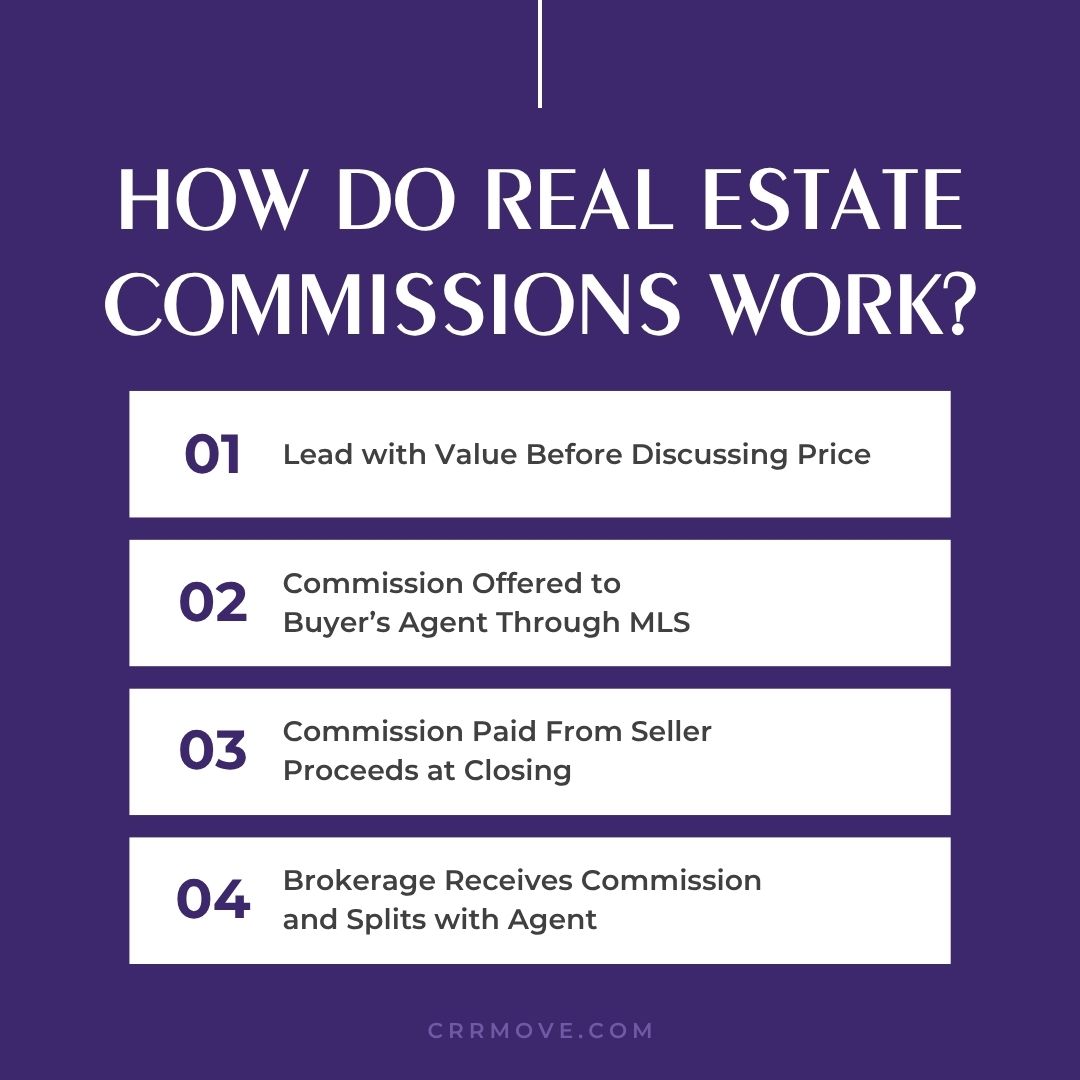
How Does Realtor Commission Work?
The listing agent negotiates the commission percentage with the seller.
When a seller and listing agent agree to work together, one of the first discussions is the total commission. This percentage is negotiated upfront and can vary based on a wide range of factors. These include market conditions, pricing strategy, and the type of property being sold.
For example, luxury properties priced in the millions often have agents working with a low commission rate (between 2% and 4%) rather than the traditional range. Since the seller pays the commission from the proceeds of the sale, this conversation happens before the home ever goes live on the market.
As of August 2024, however, there is a new option for handling real estate commissions. Sellers may now choose to pay only their listing agent, while buyers compensate their own agent directly.
As a result, this shifts the conversation about compensation to the buyer and their agent. It also gives sellers more power to negotiate commission independently for each side and offer buyer-agent compensation as a concession.
The seller pays the total commission at closing.
At closing, the agents will receive their agreed-upon commission. Depending on how compensation is structured, it may be paid by the seller, by the buyer, or by both. The commission payment is part of the closing costs required to settle and finalize the transaction.
The listing and buyer’s agents split the commission.
Traditionally, the total commission is split between the listing agent and the buyer’s agent. With newer compensation structures, however, there is greater flexibility in how agents receive commission and who pays it.
In some transactions, each party may pay their own agent under their individual agreement. In others, the process follows the traditional model, with the seller paying the full commission and the agents splitting it at closing.
An industry practice worth noting is that commissions are not always split equally. In many cases, the listing agent may earn a slightly higher percentage than the buyer’s agent. These details are negotiated between the agents and outlined as part of the Offer and Agreement of Sale.
Agents share their commission with their brokerage.
After closing, an agent will typically split their commission with a brokerage. Most real estate brokerages use a tiered structure based on experience, production, and sales volume. Common commission splits include 50/50, 80/20, or 90/10.
For instance, agents earning $15,000 on a transaction and operating on a 60/40 split, their take-home pay would be $9,000. The remaining amount would go to their brokerage.
That said, not all brokerages operate this way. Charles Rutenberg Realty Orlando offers a 100% commission model, allowing agents to retain significantly more of what they earn.
Who Pays Realtor Commission?
As previously discussed, traditionally, the home seller pays the total realtor commission at closing, with the amount funded through the proceeds of the sale. That commission is then distributed among the listing agent and the buyer’s agent. These terms will align with the listing agreement and purchase contract.
However, commission payment structures vary. Sellers may choose to compensate only their listing agent, while buyers enter separate compensation agreements. In these cases, the buyer may pay their agent directly, or the seller may offer buyer-agent compensation as a negotiation.
Ultimately, who pays realtor commission depends on the agreements in place. Additionally, they also rely on current market conditions and compensation structure. All parties involved in a sale should carefully review the terms prior to closing a deal.
How Much Commission Does a Realtor Make in Florida?
In Florida, the average real estate agent’s commission is 5.53%, which closely aligns with the national average. With the state’s average home value at $372,356, that translates to about $20,591 in total commission on a single sale. However, when split between the listing agent and the buyer’s agent, each earns roughly $10,295 before any brokerage split.
Annually, most real estate agents earn around $50,000. Moreover, agents specializing in luxury properties often see significantly higher incomes, with average earnings closer to $119,000 per year.
These figures are not fixed, though. Income in real estate is highly scalable and influenced by several factors. These can include market focus, transaction volume, property price point, and brokerage structure.
To learn more, read our guide “How Much Do Realtors Make in Florida?”
How to Get Higher Commission as a Realtor
Increase your average sales price.
Your real estate commission is tied directly to a property’s sale price. That means when you work with higher-value homes, you naturally increase your earning potential. Many Realtors choose to specialize in luxury, waterfront, new construction, or multi-unit properties in order to maximize their commission income without raising rates.
However, doing so requires a strategic approach in terms of lead generation. It means door–knocking in higher-end neighborhoods, building relationships with luxury homeowners, and positioning yourself as a polished, white-glove professional. This type of brand positioning attracts clients who value expertise and are willing to invest in it.
If you want to learn how to consistently attract clients, read our guide, “Real Estate Lead Generation Ideas.”
Improve your brokerage split.
The most effective way to increase your commission is by choosing a brokerage with a more favorable commission structure. At Charles Rutenberg Realty, our agents keep 100% of their earned commission. Instead of a percentage split, you pay a flat transaction and administrative fee. The rest is yours to keep.
As a result, agents take home more income than traditional brokerages, which keep up to 50% of every deal. Moreover, you don’t pay costly agent’s fees, commission fees, or sacrifice additional support while doing so. Charles Rutenberg Realty provides professional agent training, administrative services, and the tools you need to grow a sustainable, scalable real estate business.
If you’re considering making a move, read our guide, “How to Switch Brokerages as a Real Estate Agent and Join CRR.”
Negotiate commission strategically.
While commission rates are always negotiable, top-producing agents rarely compete on price. They compete on value.
When speaking with a potential seller, clearly outline the results that you bring when they decide to work with you. More specifically, walk them through your pricing strategy, marketing plan, and negotiation approach. Providing past examples of successful transactions, such as minimal days on the market or receiving above asking price, could influence their decision.
When sellers understand the value behind your service, they are far more willing to pay a premium commission. Presenting yourself as a knowledgeable, results-driven Realtor means clients see your commission as an investment rather than an expense.
Focus on securing listings rather than buyer representation.
The key to earning higher commissions as a Realtor is to focus on securing listings rather than solely representing buyers. Listings provide greater control over pricing, marketing, and timelines, enabling you to use your time more efficiently.
Pair that with higher-end listings, and the upside grows even more. As previously discussed, higher property values mean larger commissions without increasing your workload. By prioritizing listings, especially in premium markets, you position yourself for stronger earnings and long-term growth.
Specialize in a profitable niche.
Not all properties or clients offer the same income potential to real estate agents. When agents focus on a profitable niche, they put themselves in a stronger position to earn higher commissions. Therefore, focusing on a specific niche in the industry builds credibility, reduces fee objections, and drives higher-quality referrals.
The most profitable niches include relocation clients, investors, divorce or probate sales, and short-term rental properties. When you develop deep expertise in one of these areas, you become the obvious choice for clients. They are more confident in your value, more likely to refer you, and far less inclined to negotiate your commission.
Work both sides of the transaction (where allowed).
In some states, real estate agents are permitted to represent both the buyer and the seller in the same transaction. When allowed, this creates an opportunity to earn the full commission without splitting it with another agent.
Florida law takes a different approach. Dual agency is not permitted in the state of Florida because it can present a conflict of interest. That said, two agents from the same brokerage may represent opposite sides of the same transaction.
If you already have a relationship with one party who still needs representation, you can refer them to another agent within your brokerage. In many cases, this referral can also generate an additional referral fee, creating income without added workload.
Upsell additional services to clients.
Working as a Realtor means operating a business, and successful businesses seek smart ways to increase revenue. In real estate, that often means offering value-added services that enhance the client experience while creating additional income opportunities.
For sellers, this can include optional services such as home staging, pre-listing consultation packages, or professional photography and video. For buyers, you might offer investment analysis, relocation support, or curated local onboarding guides and service referrals to ease their transition.
These offerings don’t change your commission rate, but they do expand your earning potential. More importantly, they position you as a full-service professional who delivers more value at every stage of the transaction.
Charge a flat fee to work with buyers.
Realtors also have the option to include a flat buyer fee within the Buyer Agency Agreement. This fee can be charged in addition to any commission offered by the seller or negotiated with the buyer.
The flat fee compensates you for your time and expertise, including sourcing listings that meet the buyer’s criteria and coordinating showings. It also sets clear expectations from the start. When buyers have a financial commitment in place, they tend to be more focused, more engaged, and more serious about purchasing a home.
This approach not only protects your time, but it also reinforces your value as a professional advisor, not just a door opener.
Build a strong personal brand.
Building a strong personal brand positions you as a trusted professional, not just another Realtor. When clients see you as an authority, they’re far more willing to pay higher commissions.
The most effective way to build that brand is online. Social media allows you to stay visible to local homeowners while consistently demonstrating your expertise. For example, share market insights through short videos, publish educational blog content, and highlight testimonials or case studies from transactions in your area.
When you consistently provide value and speak confidently within your niche, you establish credibility and trust. Over time, that authority speaks for itself. Clients understand that you deliver results, and your commission reflects the professional service you provide.
Learn more about how to leverage social media in our guide, “Social Media for Realtors.”
Earn higher commissions and keep 100% of them with Charles Rutenberg Realty.
As you consider a career in real estate, understanding how Realtor commissions work is of the utmost importance. The sales-based income structure could be a breaking point for some interested parties. However, if you find yourself thrilled about the uncapped income potential and the drive needed to make sales, then becoming a Realtor may be the right path for you.
You can start your real estate career off with maximized earning and commission potential when working with Charles Rutenberg Realty. We offer unparalleled support with lead generation, transaction facilitation, and administrative services, while allowing our agents to keep 100% of their commissions.
Are you ready to discuss what working with Charles Rutenberg Realty looks like for your career? Complete our online contact form to speak with one of our valued team members today.